

This week, US president Donald Trump unexpectedly praised Ukraine's war effort and even stated that Zelensky might be able to restore his country's full borders. The statement also came with insults to Putin's army and economy. Political analyst Anton Barbashin argues that while this sounds like an explicit endorsement of Ukraine, it is in fact an announcement of Trump's departure from the peace process.
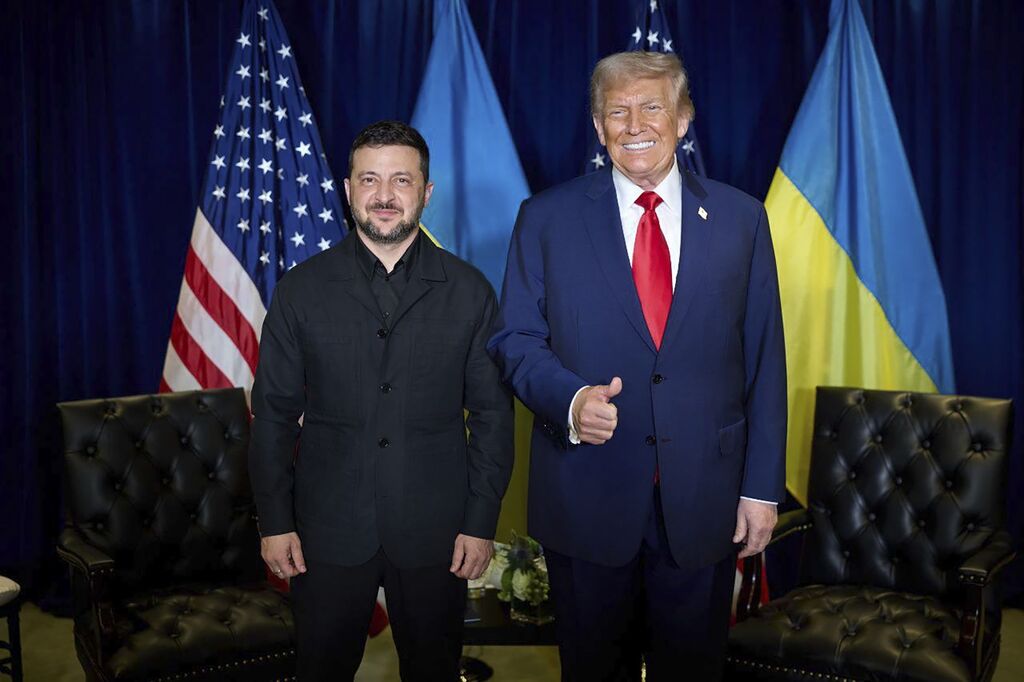
US president Donald Trump and Ukrainian president Volodymyr Zelensky meet at the United Nations headquarters in New York, 23 September 2025. Photo: EPA / ANP / PRESIDENTIAL PRESS SERVICE HANDOUT
From a diplomatic signaling and rhetoric standpoint, a near-revolution unfolded between the mid-August US–Russia summit in Alaska and President Trump’s UN speech, followed by his September 23 press conference with President Zelensky. After Alaska, Trump spoke about broad agreement with Putin, his fantastic relationship with Putin, and progress toward a peace deal in Ukraine. In the days that followed, Trump and his team openly urged Zelensky to seek a compromise, emphasising Russia’s larger size and strength and casting a Ukrainian battlefield victory as unrealistic. Just over a month later, Trump praised the Ukrainian military, suggested Ukraine could retake everything that was lost and ‘maybe even go further’, and labeled Russia a ‘paper tiger’.
On paper, this sounds like Trump’s strongest endorsement of Ukraine to date. However, I would argue this is a flashy way to announce his departure from the peace process with a calculated ‘escalation management’ posture toward Russia.

A new strategic vision
It is the best Ukraine and the EU could have hoped for. Since January, both European leaders and Zelensky have had to endure a rollercoaster of Trump’s constantly shifting attitude toward Putin and Russia. Early in his presidency, it became quite clear that there was no way his administration would continue Joe Biden’s policy of direct financial and military support of Ukraine at the expense of American taxpayers. The European Union did in fact step up, guaranteeing to give Kyiv financial backing as a response to Trump’s policy of soft disengagement. However, the EU still lacks the military-industrial capacity to provide Ukraine with the supply of arms required to at the very least meet its defensive needs.
Only the United States had the capacity to deliver sufficient amounts of military aid to Ukraine, and until very recently it was not clear whether Trump would greenlight EU-funded transfers of the required weapons. The US president prefers to call it ‘supplying weapons to NATO’, but in fact it means that the EU is importing arms destined for Ukraine. Trump’s UN speech and his subsequent discussion with Zelensky cemented this crucial development. A few crucial details still need to be determined: the pace of delivery of Patriot systems that Kyiv desperately requires to combat increased Russian missile attacks; supplies of more F-16 fighter jets; and conditions for use of long-range missiles like ATACMS, specifically how deep Ukraine would be allowed to conduct strikes on Russian territory.
Only the United States had the capacity to deliver sufficient amounts of military aid to Ukraine
Despite some lingering questions, the bottom line is clear: both the EU and Ukraine have a strategic vision of how to support Ukraine’s defense in the long run. Of course, US military deliveries to Ukraine do not exclude the EU’s efforts to simultaneously boost its own defense capabilities and military-industrial complex production capacities.
Trump’s rhetoric and positioning indicate a refusal to engage and promote Putin’s version of peace talks. In doing so, Washington is no longer exerting pressure on Kyiv to seek a compromise based on a Russian version of a proposal, which it was doing only a month ago. This disengagement from the process also likely torpedoes the discussion about post-war security guarantees for Ukraine, but that may not be such a problem since these discussions were based on the incorrect interpretation of Russian proposals. While European nations were discussing sending forces to Ukraine with US backing, Moscow systematically clarified that it would only agree to security guarantees if Russia could act as a guarantor of Ukraine’s post-war security, with veto power over any decision. Any version of security guarantees based on Moscow’s vision is fully unacceptable to Ukraine, so the discussion about security guarantees was unlikely to provide results in the near future anyways.
What does Moscow get out of this?
Trump’s harsh rhetoric—humiliating the Russian army by calling it a ‘paper tiger’, suggesting the restoration of the 1991 borders, and even hinting at the Ukrainian occupation of some of Russia’s internationally recognized territory—was quite offensive to Putin. However, Putin and his office are generally accustomed to political leaders in democratic nations drawing distinctions between public rhetoric, private conversations, and actual policy. This has certainly been the case with Donald Trump and his ever-changing comments about Russia. If we ignore certain Russian hawks that spew fire publicly, we can clearly see that the Kremlin was continuously open to more talks.
On the eve of Trump’s UN address, Putin unsurprisingly held a Security Council meeting in Moscow that focused on strategic international security and the role of US-Russia agreements on nuclear arms, specifically the New START treaty which is set to expire on February 4, 2026. Putin made it very clear that he blames Biden for the deterioration of strategic security, and very openly invites Trump to negotiate the continuation of this treaty, even offering to extend Russia’s compliance with its provisions for a year after it expires in February.
Reading Trump’s character, Putin is dangling a low-effort win: to prolong the treaty ahead of the 2026 US congressional elections and claim Reaganesque stature for averting nuclear risk. As usual with Moscow, one negotiation opens the door to another negotiation, and one topic can morph into many.
Although Trump went hard on Moscow, this option is not closed—Russian diplomacy will keep bringing this offer up, and even if not now, there is a great chance Trump will decide not to break the last remaining tool of international stability that the Soviet Union and the USA agreed to.
Putin is dangling a low-effort win
A key element that could be overlooked in Trump’s speech is his refusal to introduce new sanctions on Russia. Trump’s last 10-12 day deadline on Russia with a promise of sanctions was announced on July 28th. The threat of secondary sanctions was a major point of concern for Moscow, as they would have implied 100% US tariffs on any nations that buy Russian energy, with the three most obvious targets being China, India, and Turkey. Trump did in fact introduce 25% tariffs on India, a move that was largely viewed as a major blow to US-India relations. Instead of just backtracking, Trump has since demanded that the EU proceed with similar measures, starting with a complete halt to Russian energy imports. Given that the EU is currently not able to comply, Trump has freed his hands to de facto refuse the introduction of any new sanctions on Russia.
This is not a victory for Moscow, but it seems to answer the question of how far Trump is willing to go for Ukraine: he is willing to sell arms to the EU in Ukraine’s name, and that is all. This dynamic does not advance Russia’s desire to reconcile with the USA, but it does allow Moscow to fully refocus on combating Ukraine while pressuring and intimidating the EU, without fears that Trump will retaliate.
What comes next?
All of the involved parties now have a conclusive answer—the war in Ukraine will continue for as long as Ukraine can fight, and for as long as Russia can handle this war. Major uncertainty about what should be expected from Trump is now gone, but it doesn’t mean Trump can fully escape dealing with ‘Europe’s war’. Moscow is bound to continue trying to make Trump come back to the table, either via talks about the New START Treaty, or via other areas of interest that could include the Middle East, the Arctic, or any other ad hoc development that may offer a chance to re-engage. And of course, the White House will have to re-enter the picture if there is a major military shift, leading to conditions for accepting a different version of peace talks.
But if Moscow succeeds in forcing an agenda of US-Russia talks and cooperation which actively ignores Ukraine, then that would certainly be a victory for Moscow.
10 jaar RAAM: wij hebben uw hulp nodig
In 2026 bestaat RAAM 10 jaar. Het is geen vanzelfsprekendheid dat we blijven voortbestaan. Daarvoor hebben we uw hulp nodig. Met uw giften kunnen wij auteurs een bescheiden honorarium betalen, onderzoek doen en Kennisplatform RAAM overeind houden. Wij zijn een ANBI: uw gift is aftrekbaar van de belasting.