
Ukraine and Poland are embroiled in a serious political and historical dispute, which is heavily damaging relations between the two neighbors. Mykola Riabchuk explains how the conflict escalated, and argues that it is in the best interests of both countries to focus on reconciliation, even though that may not happen soon.
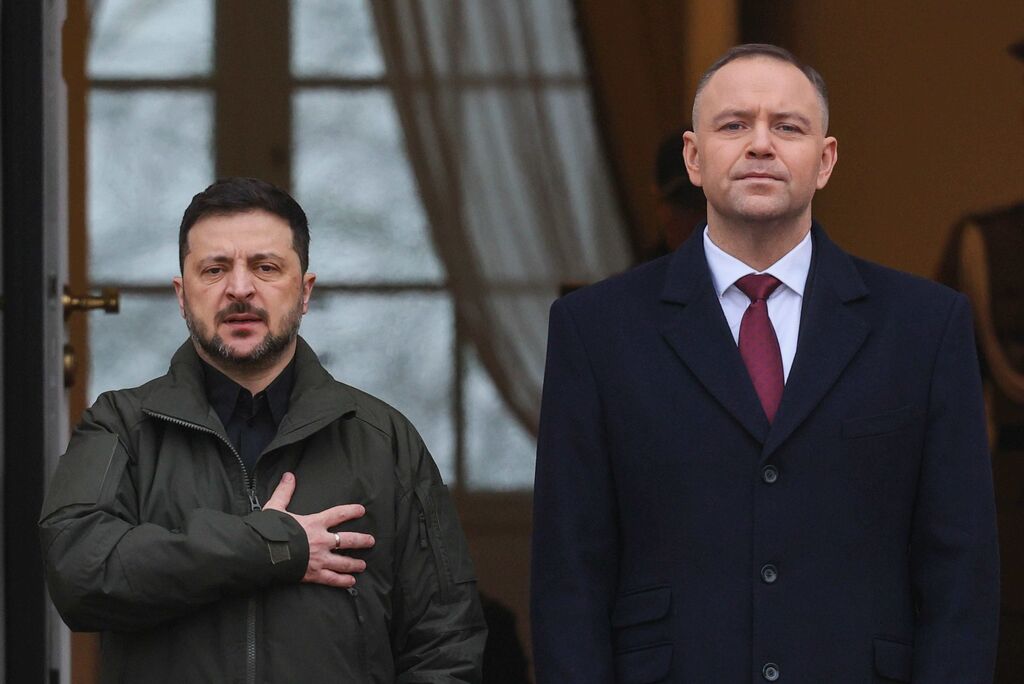 Polish President Karol Nawrocki and Ukrainian President Volodymyr Zelensky attend an official welcome ceremony before their meeting at the Presidential Palace in Warsaw, Poland, 19 December 2025. Photo: Pawel Supernak / ANP / EPA
On May 26, a decree by Ukrainian President Volodymyr Zelensky granted the honorary name 'Heroes of the UPA' to a special forces unit of the Ukrainian army. The move was broadly condemned in Poland as a political provocation: specifically, as an attack on Polish collective memory, identity, and sense of victimhood. It is the latest in a series of symbolic gestures by both Ukrainian and Polish political leaders that have contributed to a further deterioration of Polish-Ukrainian relations and deepened the chasm of mutual misperception regarding their shared past.
Historical dispute
The UPA, the Ukrainian Insurgent Army, was created in 1943 in Western Ukraine by the pre-war, clandestine Organization of Ukrainian Nationalists (OUN) with the declared goal of fighting all occupying forces on Ukrainian land, primarily the Soviets and Germans, and using the inevitable post-war turmoil and presumed power vacuum for the forcible creation of an independent Ukrainian state. They imagined the end of the Second World War more or less like the First World War, when they declared, in 1918, the West Ukrainian National Republic on the ruins of the Habsburg Empire but ultimately lost to a much stronger and better-prepared Polish force.
Zelensky's decree was broadly condemned in Poland as a political provocation
This historical trauma and false analogy between the two world wars largely determined the UPA’s eventual policies and miscalculations. On the one hand, they refused to recognize the legitimacy of Polish power in West Ukrainian lands, especially after the Poles reneged on their promise to grant Ukrainians autonomy in their newly established—or re-established, as they contended—state. On the other hand, the most radical UPA factions put their bets on the 'integral' or totalitarian version of nationalism, which was quite popular at the time in Europe, and sought opportunistic alliances with the post-WWI revisionist powers that could break the international order and thereby give Ukrainians a chance for independent state-building. Concurrently, they engaged in all kinds of sabotage and terror against the Polish state, which, in turn, became increasingly discriminatory and repressive against ethnic and religious minorities.
In 1943, the deep Polish-Ukrainian animosity culminated in the UPA-led ethnic cleansing of the Polish population in the West Ukrainian region of Wolyn. This resulted in the killings of about 80,000 Poles, who refused to leave the territory upon the UPA's ultimatum, and about 30,000 Ukrainians who died in so-called retaliatory—and quite often 'preemptive retaliatory'—actions by the Polish underground Home Army and local self-defense units, a fact rarely mentioned in today's Poland.
Differing historical views
This understandably makes both the OUN and UPA, along with all their leaders, deadly enemies of the Polish nation, often compared to German Nazis in public discourse. This comparison persists even though relations between the UPA and the German authorities were unambiguously hostile and confrontational: in 1941, Germans actually arrested all the nationalist leaders and either killed them or sent them to concentration camps, including their notorious leader Stepan Bandera.
The Ukrainian view of the OUN and especially of the UPA is substantially different. Although they have little appetite for the dictatorship and authoritarianism associated with it, and have increasingly distanced themselves from the UPA's anti-Polish 'excesses' in Wolyn, Ukrainians nonetheless praise the UPA's struggle against both Germans and Soviets as an example of patriotic resistance, self-sacrifice, and unwavering commitment to the national cause.
The OUN and UPA are seen as deadly enemies of the Polish nation
This attitude evolved gradually in different parts of Ukraine. Since the OUN, UPA, and Bandera had been heavily demonized by the Soviets as 'Nazi collaborators', East Ukrainians had largely internalized this view. The UPA’s heroism, therefore, was celebrated initially only in Western Ukraine, where people had personal or family reasons for sympathizing with the underground movement.
The 2014 Russian invasion of Ukraine and especially the 2022 full-scale war have made the UPA narrative of national resistance and patriotic self-sacrifice highly topical far beyond Western Ukraine. UPA symbols and its leaders' names, so hated by Moscow, initially spread to Central Ukraine and gradually to the heavily Russified southeast.
‘Heroes of the UPA’ military unit
The latest decision by the Ukrainian president to give the name 'Heroes of the UPA' to an elite army unit was certainly not his own initiative, and was probably not a reflection of his personal admiration for the UPA, an organization of which he, like most East Ukrainians, knows little besides the Soviet propaganda that has been completely discredited nowadays. Rather, it was Zelensky's compliant response to a bottom-up request from the military unit itself.
The problem is that the Ukrainian heroic myth of the UPA clashes dramatically with the demonic myth of the same UPA developed in Poland. In both countries, these myths are instrumentalized politically: in Ukraine, for the sake of mobilization against the external Russian enemy, while in Poland the goal is to mobilize a loyal electorate against domestic, liberal, and cosmopolitan rivals.
Karol Nawrocki, who won last year's presidential elections largely with the support of far-right and ultranationalist voters, seems to be well aware of the power of this symbolic instrument. This is probably why he reacted to Zelensky's faux pas so aggressively: he did not just condemn his unfortunate decision, which could have been regular diplomatic practice, but threatened to revoke the Polish Order of the White Eagle bestowed upon Zelensky by his predecessor.
In both Poland and Ukraine, historical myths are instrumentalized politically in different ways
Zelensky predictably did not give in, so Nawrocki had little choice but to act upon his threat. This further increased the temperature of the conflict, prompting Zelensky to send the order back to his Polish counterpart by regular mail and inciting many other Ukrainian officials, including three former Ukrainian presidents who are no friends of Zelensky, to follow suit and strip themselves of Polish regalia.
Ukrainian public opinion was originally divided on Zelensky's decision to name the military unit after the 'UPA heroes', citing both Polish concerns and wartime pragmatism as arguments for their doubt. Nawrocki's decision, however, evoked almost unanimous condemnation from the Ukrainian side. It was perceived as an insult not merely to Zelensky but to the entire Ukrainian populace, whose heroism and self-sacrifice had been symbolically epitomized in that unfortunate medal.
Further escalation
The conflict escalated further as Volodymyr Zelensky changed his traditional point of departure for international trips from the Polish city of Rzeszów to the Moldovan capital Chişinǎu, and skipped the highly important Ukraine Recovery Conference in Gdansk on June 25-26, instead authorizing Prime Minister Yulia Svyrydenko to head the Ukrainian delegation.
Recently, Zelensky also submitted the law on the Ukrainian National Pantheon to parliament. He boltly stated that 'the names of all the heroes who have fought for Ukraine and inspired Ukraine in different centuries and eras will be united and forever inscribed in our history with a capital letter, with great respect and attention from the state: Ukraine, which respects itself, values its people, and defends what is its own—its right to be Ukrainian. Where no one will ever dictate how we live, how we speak, who we love, who we should be grateful to, or which heroes we should honor.'
Prime minister Tusk has called for restraint, reminding everybody that there is a war going on and that conflicts like this play into Moscow's hands
Nawrocki's office responded immediately: 'Has Ukrainian society ever considered whether its kleptocratic elites actually want to join the European Union?', the head of Nawrocki's international desk, Marcin Przydacz, wrote on X. 'It is, of course, easier to provoke and stir up historical tensions so as not to have to account for the lack of reforms, the lack of an effective fight against corruption, the lack of real de-oligarchization, the lack of real improvements for entrepreneurs, the lack of the rule of law, the lack of infrastructure improvements, and the lack of many other things that these elites have failed to deliver over the past three decades. Do they really want to join the EU, or are they just feeding lies and deceiving their own voters, who are growing increasingly disillusioned with such a government?'
So far, EU officials prefer not to interfere in the conflict, while the Kremlin spitefully gloats and cheers. This prompted Polish prime minister Donald Tusk and minister of Foreign Affairs Radosław Sikorski, both political opponents of Nawrocki, to call for restraint, reminding everybody that there is a war going on and that conflicts like this play into Moscow's hands.
The call has been well received in Ukraine, and politicians seem to have tamed their provocative gestures and rhetoric slightly. But this will probably have little impact on the Polish president, whose entire political career has been built on narcissist chauvinism, confrontational rhetoric, and well-calibrated Ukrainophobia—starting from his controversial appointment as director of the Museum of the Second World War in Gdansk and his directorship of the notorious Institute of National Remembrance, to his electoral victory last year with strong support from far-right nationalists and neo-fascist. Nawrocki is likely to follow the path that brought him success against his liberal rivals, and to continue poisoning Polish society with intolerance, xenophobia, and historical resentment.
Nawrocki will likely follow the confrontational path that already brought him success
Moral objections aside, Nawrocki’s policy clearly pays off. The latest opinion poll indicates an 8.4% increase in the president's popularity, from 46.8% to 54.8%, after a slow but steady decline since he assumed office. The result does not yet guarantee him and his party a victory in next year's parliamentary elections, but it clearly proves that nationalism is still an effective instrument for political mobilization.
His moderate rivals, who refrained from anti-Ukrainian accusations, performed much poorer in the same poll. Only 38% of respondents declared trust in Prime Minister Donald Tusk, against 58% distrust, and 43% versus 52% declared trust and distrust in Radosław Sikorski. The results come as little surprise since the Poles overwhelmingly blame Volodymyr Zelensky rather than Karol Nawrocki for the current dispute between the two countries, by 62% to 19%.
 Ukrainian president Zelensky and Polish prime minister Donald Tusk in Warsaw in 2025. Photo: Pawel Supernak / ANP / EPA
Timing of the conflict
Professor Slawomir Lukasewicz of the John Paul II Catholic University in Lublin raises an interesting question about the timing of Nawrocki's attack: why did he act exactly now, in May and June, even though there were several other suitable moments to play the 'anti-nationalist' card?
For example, in January this year, Volodymyr Zelensky granted the name of Vasyl Kuk, the last commander-in-chief of the UPA, to another unit of the national armed forces, the 190th Training Center of Unmanned Systems. In March, the government approved the construction of the National Pantheon, and eventually organized there the reburial of Andriy Melnyk, the leader of the rivaling OUN faction, who died in 1964 in Luxembourg. Volodymyr Zelensky, who took part in the official ceremony, emphasized the historical continuity between the UPA and today's Ukrainian armed forces, which heroically fight the same enemy. He also announced the eventual reburial of Yevhen Konovalets, the founder and leader of the OUN since 1929, who was murdered in Rotterdam in 1938 by a Soviet agent.
But none of this stirred agitation in Warsaw, and only in May did Karol Nawrocki discern Zelensky's missteps. He may really have noticed a decline in his ratings and decided to boost them ahead of next year's parliamentary elections by using the familiar tools of Ukraine and UPA bashing, as Professor Lukasewicz implies. But there could be more to it: the names of Kuk, Melnyk, and Konovalets do not tell the average Pole much without additional explanation, while the word 'UPA' works like a red rag. When conflated with the word 'heroes', rather than bandits, devils, or criminals, it challenges the convenient Polish myth of the UPA as primordial evil.
There were several other suitable moments to play the 'anti-nationalist' card
In any case, it is very unlikely that Nawrocki would be satisfied with any Ukrainian concessions short of a full and unconditional acceptance of the Polish version of their shared history, something that is far beyond Zelensky's capacity and, indeed, is not fully achievable even in Poland itself.
What Ukrainians really can do in this difficult situation is not to appease the Polish president, as there are little chances of success anyway, but to try not to give him any additional cards in his fight against domestic enemies—the incumbent liberal government headed by Donald Tusk and his moderate, responsible Foreign Minister Radosław Sikorski. We should remember that liberals who appeal to people's minds and civility often lose free elections to radicals who appeal to raw emotions and basic instincts. The new far-right coalition that may take all branches of power in Poland next year could be much more disastrous for Ukraine than Nawrocki himself.
Zelensky may lack experience, but he has good intuition and seems to learn fast. After last year's scandal with Trump and Vance in the Oval Office and his subsequent expulsion from the White House, he recognized promptly and properly that concepts like solidarity, justice, international law, and democratic values simply do not exist in Trump's universe, and therefore it makes no sense to evoke or rely on them. He learnt how to behave with Trump, and maybe he will learn how to behave with Nawrocki, even though the task might be more difficult, because Nawrocki is not merely a narcissist but is also ideologically driven. It seems that Ukraine—meaning a demonic, primordial, and essentialized 'Ukrainian nationalism'—is a focal point of his peculiar witch-hunt ideology.
Leaving history to historians
It would be advisable for Ukrainian officials to distance themselves from the highly complex, convoluted, and controversial history of the UPA, leaving its study to historians, its alleged crimes to investigators and lawyers, and its celebration or commemoration to local communities, preferably non-state actors.
This should be done for both normative and practical reasons. The UPA's unconditional heroization and whitewashing is as false and wrong as its total demonization. There are too many complexities and nuances that require detailed explanation, clarification, and contextualization. Even a Ukrainian audience may not fully grasp this historical, geopolitical, social, and cultural totality, let alone foreigners who, at best, know nothing about this, but more often know something gleaned from Russian propaganda conflated with their own oriental clichés.
It would be advisable for Ukrainian officials to leave the study of history to historians
In practical terms, we have neither the time nor the resources to fight all the stereotypes and explain all the complexities and nuances that most people are not aware of and, in most cases, are not very eager to learn. Living with stereotypes is comfortable, learning is tiresome, and questioning common wisdom is painstaking.
This is an uphill battle that an impoverished, bleeding Ukraine cannot fight. We have a clear priority: to survive the genocidal war that Russia wages against us. Which means, inter alia, not wasting scarce resources on things of secondary importance and on problems that are currently unsolvable. We are fighting an existential war and strongly depend on our friends and partners to win it. We simply cannot afford to alienate them by either real or imaginary disrespect. First things should be done first, and all other things can be discussed after the war.
10 jaar RAAM: wij hebben uw hulp nodig
In 2026 bestaat RAAM 10 jaar. Het is geen vanzelfsprekendheid dat we blijven voortbestaan. Daarvoor hebben we uw hulp nodig. Met uw giften kunnen wij auteurs een bescheiden honorarium betalen, onderzoek doen en Kennisplatform RAAM overeind houden. Wij zijn een ANBI: uw gift is aftrekbaar van de belasting.