The two Georgian breakaway regions of Abkhazia and South Ossetia are portrayed as two sides of the same story. However, their political realities are more complex because each has its own priorities, internal dynamics, and competing interests. PhD researcher Leonardo Zanatta explores the inner workings of these self-declared republics, arguing that while both remain heavily dependent on Russia, neither Abkahzia nor South Ossetia can be simply understood as a Russian puppet state.
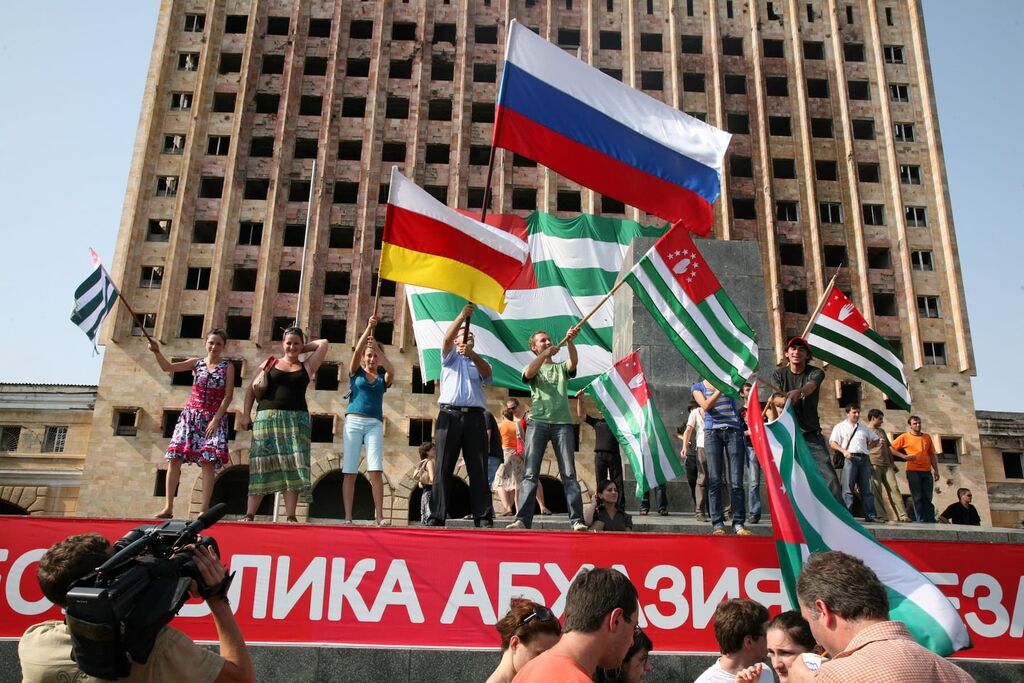 Residents of Sukhumi, the de facto capital of Abkhazia, wave the flags of Abkhazia, South Ossetia, and Russia in celebration of the recognition of their independence by Russia on August 26, 2008, shortly after the Russo-Georgian War. The ruined building behind them once housed the parliament of Abkhazia; it was destroyed during a previous war in the 1990s between Abkhaz separatists and Georgian government forces. Photo: ANP / AFP PHOTO / STR
Few regions have felt the shock waves of Russia’s full-scale invasion of Ukraine as acutely as the Caucasus. North of the mountains, inside the Russian Federation, the war has accelerated the militarization of local societies. Large numbers of soldiers are sent to the front, while Ukrainian drone strikes are coming closer to home. To the south, the Kremlin’s military overstretch and waning regional engagement have given Armenia, Azerbaijan, and Georgia more room to rethink their foreign policy choices and geopolitical alignments in what was once widely regarded as its 'backyard'.
Abkhazia and South Ossetia sit uneasily between these two worlds. Both lie within Georgia’s internationally recognized borders, but beyond its effective control. Their wars with Tbilisi in the early 1990s, followed by the Russo-Georgian war in 2008, have shaped the political fault lines of the South Caucasus for decades. Yet both territories remain firmly tethered to the north. Their survival as de facto independent entities depends on Moscow. At the same time, longstanding cultural and social ties bind them to communities across the mountains, particularly the Circassians in Abkhazia’s case and the Ossetians of North Ossetia in South Ossetia’s.
Both self-proclaimed republics have backed Moscow’s military effort, but neither has emerged unscathed. Russia’s battlefield setbacks and the conflict's mounting costs have compounded their longstanding challenges at home. Meanwhile, speculation about their future has resurfaced. In the invasion’s first months, Ukrainian officials urged Georgia to open a second front against Moscow by reclaiming Abkhazia and South Ossetia. On the other side, reports suggested that the Kremlin might seek to offset territorial losses in Ukraine by annexing the two territories.
Both self-proclaimed republics have backed Moscow’s military effort against Ukraine, but neither has emerged unscathed
Much of the commentary on these scenarios rests on two broader, fundamentally flawed assumptions about Abkhazia and South Ossetia since 2008. The first is that the two self-proclaimed republics are little more than Moscow’s puppets. Such interpretations overlook how the two self-proclaimed republics, despite their dependence on the same powerful patron, have sought to shape the relationship according to their own ambitions and constraints. The second is that the highly centralized and authoritarian nature of the Russian political system necessarily translates into a uniform approach to the two territories. Yet the Kremlin’s policies in the Caucasus have evolved over the years, as responsibility for managing its interests has passed between officials with different priorities.

The drums of war reach the Caucasus
When Russia recognized the so-called Donetsk and Luhansk People’s Republics on 21 February 2022 and launched its full-scale invasion of Ukraine three days later, the leaders of Abkhazia and South Ossetia swiftly rallied behind Moscow. In their first public reactions, South Ossetia’s then-president, Anatoliy Bibilov, echoed Putin’s calls to 'demilitarize' and 'denazify' Ukraine, while his Abkhaz counterpart, Aslan Bzhania, called Moscow’s actions 'absolutely justified' and formally recognized Donetsk and Luhansk.
That support had roots in the war that began eight years earlier. South Ossetia recognized Donetsk and Luhansk in June 2014, just months after pro-Russian separatists seized government buildings in eastern Ukraine. Bibilov, who would become president in 2017, made repeated visits to separatist-held territories, drawing sanctions from Kyiv as early as 2015. Fighters from both South Ossetia and Abkhazia, including veterans of the 2008 war, also joined the fighting.
The full-scale invasion deepened that involvement, with South Ossetia sending more men to the front. Under a 2017 agreement that brought parts of its armed forces into the Russian military, South Ossetian servicemen stationed at Russia’s 4th Military Base were deployed to Ukraine. Others joined as volunteers, fighting alongside fellow Ossetians from North Ossetia in the newly established Alania, Sarmat, and Shtorm Ossetia battalions.
Abkhazia’s contribution, by contrast, has rested more on its strategic position along the Black Sea coast. While individual volunteers have joined the fighting, the de facto authorities have sent no official military units to Ukraine. Nonetheless, as Ukrainian strikes placed Russia’s Fleet under mounting pressure in Crimea, Moscow began looking for safer naval facilities farther along the coast. In October 2023, the breakaway authorities announced an agreement to expand Russia’s existing naval presence at Ochamchire in Abkhazia with a basing point for Russian Navy vessels.
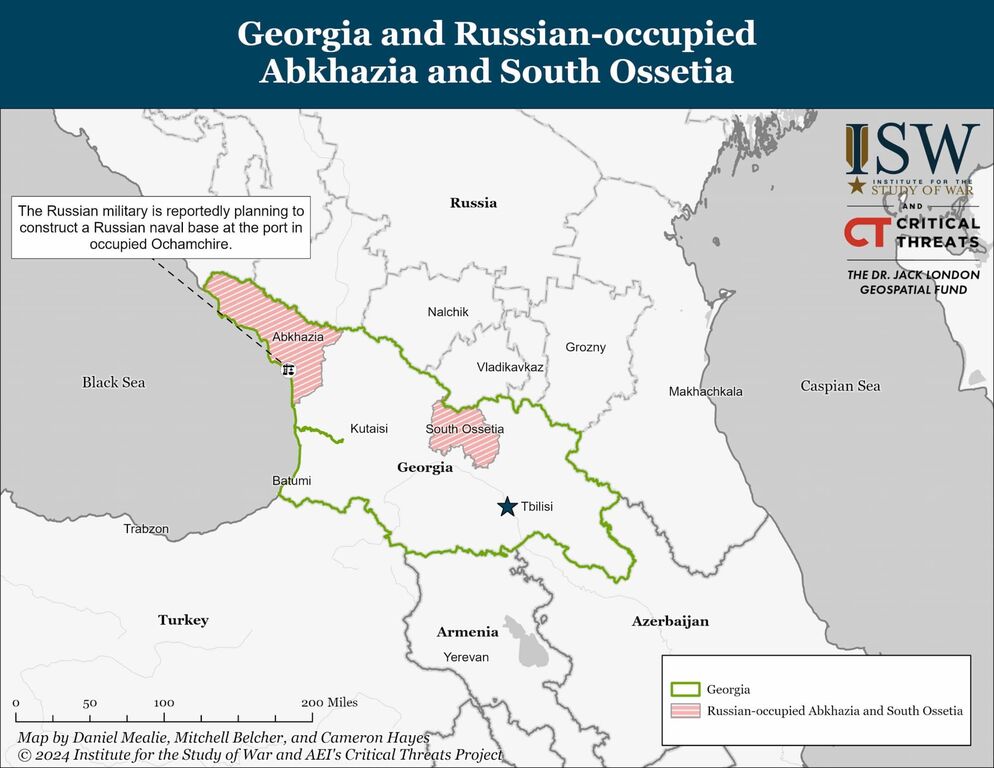 A map showing the breakaway territories of South Ossetia and Abkhazia, as well as the location of the Russian naval presence at Ochamchire. Source: Institute for the Study of War
Material interests help explain why Abkhazia and South Ossetia have stood by Moscow, since support for the war partly reciprocates the assistance both territories depend on. For those heading to the front, the incentives are more immediate, with Russian military contracts offering earnings far beyond what most could expect at home. In 2024, monthly payments for contract soldiers serving in Ukraine started at around 210,000 rubles, roughly seven times the average wage in Abkhazia and South Ossetia. For some, enlistment has also offered an escape from legal problems at home.
Yet money and expediency tell only part of the story. The war also stirs memories of earlier conflicts with Georgia. Defending Moscow’s actions, Aslan Bzhania recalled the Ukrainian nationalist volunteers who had fought alongside Georgian forces in 1992–1993. South Ossetian political figures I interviewed for an earlier RAAM article made a similar connection, pointing to the Georgian Legion fighting for Kyiv.
In 2024, monthly payments for contract soldiers serving in Ukraine started at roughly seven times the average wage in Abkhazia and South Ossetia
Although Abkhazia and South Ossetia have found similar reasons to align themselves with Moscow, their expectations of this relationship have differed. Since Russia recognized their independence in 2008, each has sought its patron’s support for a distinct vision of its political future.
South Ossetia: integration on Moscow’s terms
For South Ossetia, independence has never necessarily been an end in itself. What began in the waning years of the Soviet Union as a bid for greater autonomy within Georgia evolved into a struggle to reunite with their ethnic kin across the mountains in the newly born Russian Federation. That ambition has remained central to the self-proclaimed republic’s political agenda. In May 2022, Anatoliy Bibilov signed a decree calling a referendum on joining Russia. Moscow, for its part, showed little inclination to move in that direction, prompting Bibilov’s successor, Alan Gagloyev, to put the vote on hold pending consultations with the Kremlin.
Formal accession has been shelved for now, but integration has continued. In May 2026, Gagloyev and Putin inked a treaty on 'Deepening Allied Cooperation' in Moscow, bringing the two sides even closer across areas as diverse as economic policy, legislation, energy, transport, education and healthcare. Gagloyev hailed the document as the beginning of the reunification of the Ossetian people.
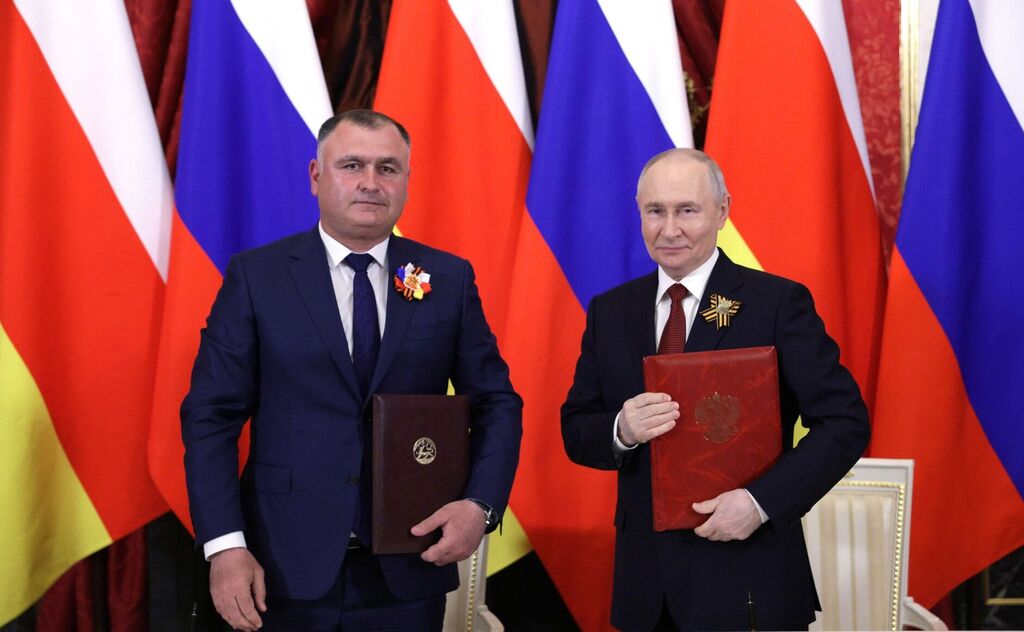 . The former 'president' of South Ossetia, Alan Gagloyev, meets with Russian president Putin to sign a new treaty on deepening cooperation between the breakaway territory and Moscow in May 2026. Photo: kremlin.ru
Shortly after his trip to Moscow, he appointed Marat Kambolov, a North Ossetian with a long career in Russian federal institutions, as a state adviser responsible for implementing the treaty in the economic and social spheres. Kambolov rose to power in less than four months. After becoming prime minister in June, he assumed the acting presidency a week later, when Gagloyev stepped down and accepted Putin’s offer to join the Russian presidential administration as an adviser. In September, he completed his ascent with a landslide victory in the presidential elections, taking 85 percent of the vote.
The treaty and leadership change have prompted Western and Georgian observers, as with every agreement between Moscow and the self-proclaimed republics since 2008, to warn anew that Russia’s annexation of South Ossetia is imminent. Yet Russian nationals held senior posts in this territory long before the latest agreement. This already established practice has allowed the Kremlin to exercise considerable influence over the self-proclaimed republic without formally incorporating it. As the shelving of the 2022 referendum shows, Russia has been reluctant to proceed with annexation. This move could jeopardize Moscow’s increasingly valuable relationship with Georgia just as its ties with Armenia and Azerbaijan face growing strain.
Formal annexation could jeopardize Moscow’s increasingly valuable relationship with Georgia just as its ties with Armenia and Azerbaijan face growing strain
Observers also seem unwilling to consider that the Kremlin’s increasing assertiveness in South Ossetia stems from frustration with the local elite. Allegations of corruption have repeatedly dogged the de facto authorities’ handling of Russian funding, while petty crime and cross-border smuggling remain persistent problems. With the war in Ukraine consuming resources and straining the Russian economy, Moscow has signaled that its tolerance for such practices is wearing thin. Ahead of the September election, Kambolov met with Sergei Kiriyenko, who became the Kremlin’s overseer for Abkhazia and South Ossetia in late 2024, to discuss these issues. The meeting offered Kambolov a clear endorsement from Moscow, strengthening his credibility in a territory where he had arrived as an outsider.
Finally, most accounts understate South Ossetians’ growing distrust of a political elite that repeatedly failed to address their longstanding problems. Low wages and scarce employment have steadily driven residents to seek work in North Ossetia, deepening an already serious demographic decline. Until recently, the breakaway authorities had made little effort to convince Moscow to ease South Ossetia’s isolation. Cut off from Georgia, this territory depends on one mountain road to Russia and the outside world. Staff shortages and queues at the crossing repeatedly delayed travelers and goods. Kambolov addressed the frustration by visiting the de facto checkpoint and pressing officials to improve its operation.
Most accounts understate South Ossetians’ growing distrust of a political elite that repeatedly failed to address their longstanding problems
Abkhazia: 'independence' under pressure
Despite depending on Russia for security and substantial financial assistance, and on Russian tourists as a major revenue source, Abkhazia has preserved independence as a defining political aspiration. This logic applies to Tbilisi as much as to Moscow, which Abkhaz authorities have consistently regarded as their closest ally while remaining wary of efforts to translate that relationship into deeper integration.
This caution was already apparent in 2014, when the two self-proclaimed republics negotiated integration treaties with the Kremlin. While South Ossetia brought its defense and security structures increasingly under Russian control, Abkhazia rejected the Kremlin's initial draft. It ultimately secured terms that let it retain its own armed forces and greater discretion over participation in joint operations.
Russia’s considerable influence over Abkhazia does not always guarantee the concessions it seeks, especially when the self-proclaimed republic's population views such demands as infringements on its sovereignty. For example, the de facto authorities have resisted opening the residential market to Russian citizens, fearing wealthier buyers could quickly acquire much of the territory’s prized Black Sea real estate. These sensitivities came to the fore in 2022, when an agreement transferring the Pitsunda state dacha to Russia became public and sparked protests.
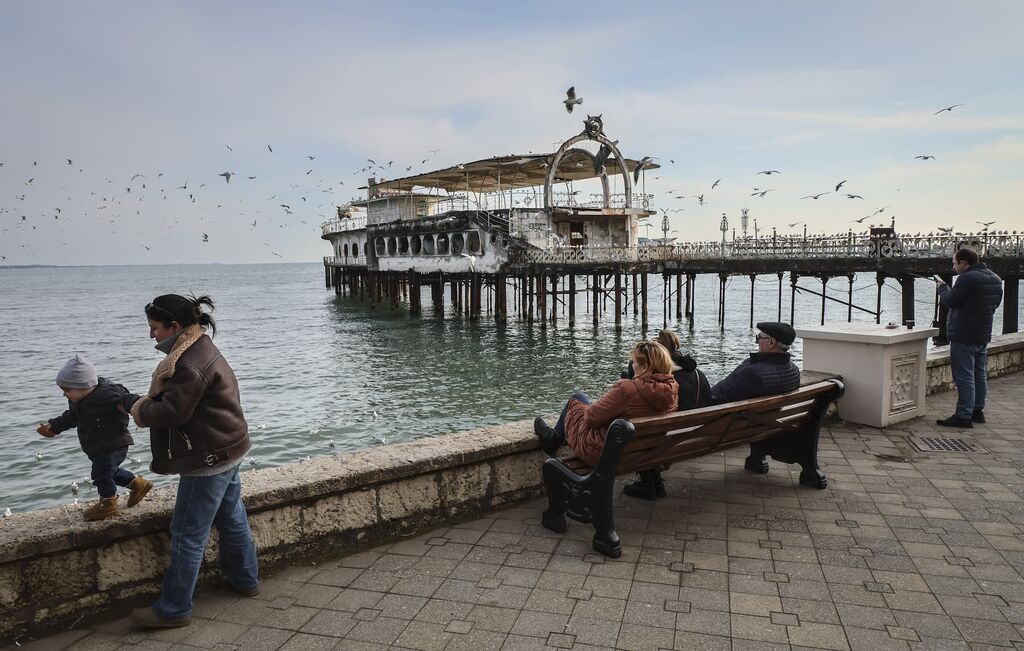 The Abkhaz economy still is very much dependent on Russian tourism. Its Black Sea coastline, with its mild climate and Soviet-era sanatoriums, continues to attract primarily Russian tourists, despite aging infrastructure and remnants of past conflict. Photo: ANP / EPA / YURI KOCHETKOV
Tensions between the two sides reached new heights in 2024, as the Kremlin grew increasingly impatient with Abkhazia’s refusal to open its property market to Russian citizens. In September, Moscow suspended part of its financial assistance and withdrew preferential electricity supplies to pressure the separatist authorities into concessions. Reports also emerged that Abkhaz lawmakers opposing the property legislation risked losing their Russian citizenship.
The confrontation came to a head in November, when the Abkhazian government sought to accommodate Moscow through a separate agreement offering preferential terms to Russian investors. The deal triggered mass protests and the occupation of government buildings, ultimately leading President Aslan Bzhania to resign. The Abkhazian parliament rejected the agreement the following month.
True, the self-proclaimed republic remained vulnerable to Russian pressure. Seasonal energy shortages, compounded by the loss of preferential electricity supplies, had left the territory struggling to keep the lights on. By December, prolonged blackouts had drained its financial resources, prompting Moscow to step in with renewed assistance. Russian Foreign Ministry spokesperson Maria Zakharova made clear that this gesture of goodwill required the self-proclaimed republic to honor its commitments, including those surrounding the contentious investment agreement.
Nonetheless, the brief but consequential confrontation with Abkhazia appears to have shown the Kremlin the limits of its former strategy of financial pressure and prompted a change in approach. Kiriyenko became the public face of this shift during the 2025 presidential campaign. His outspoken support for Badra Gunba, Bzhania’s former deputy, was accompanied by frequent visits and initiatives to ease electricity shortages, improve pension payments, and provide school buses and medical assistance. These efforts were part of a new strategy to demonstrate that closer ties with Moscow could deliver tangible benefits to the Abkhazian people.
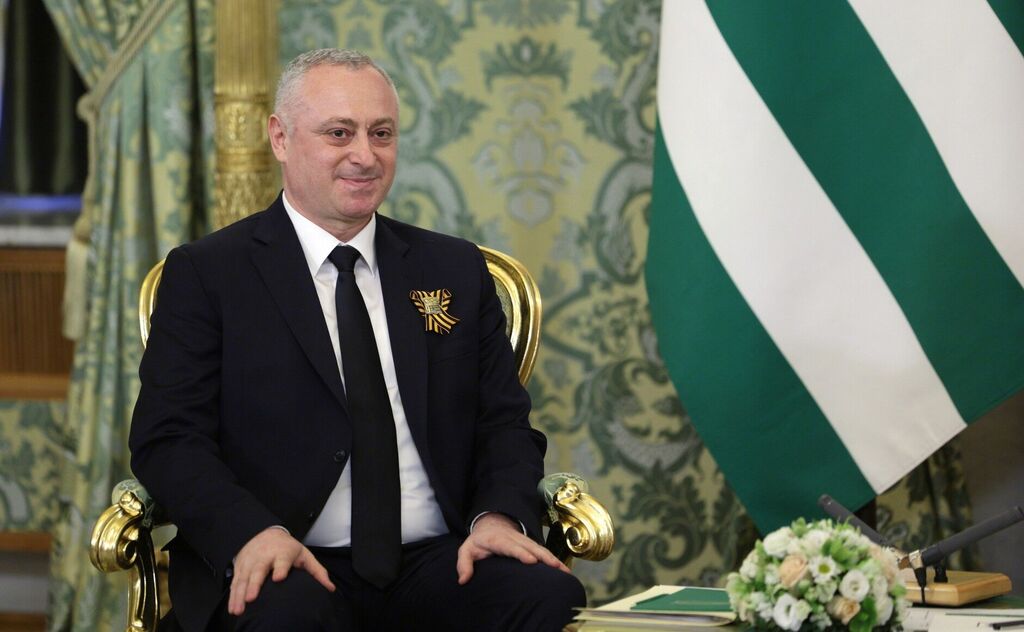 The de facto head of the self-declared Republic of Abkhazia, Badra Gunba, during an audience with the Russian president Putin in May 2026. Photo: kremlin.ru
The strategy appears to have paid off. After winning the March 2025 presidential runoff, Gunba traveled to Moscow to reaffirm the alliance and pledge closer cooperation, seeking to reassure the Kremlin while buying time to secure approval of the investment bill.
At the same time, the appointment of Kiriyenko’s close associate Vyacheslav Gladkov – the former Belgorod governor – as Russia’s ambassador to the self-proclaimed republic in June 2026, further reflects Kiriyenko’s effort to strengthen ties with Abkhaz society. Recently, he pledged to stay in close contact with local communities and learn Abkhaz.
10 jaar RAAM: wij hebben uw hulp nodig
In 2026 bestaat RAAM 10 jaar. Het is geen vanzelfsprekendheid dat we blijven voortbestaan. Daarvoor hebben we uw hulp nodig. Met uw giften kunnen wij auteurs een bescheiden honorarium betalen, onderzoek doen en Kennisplatform RAAM overeind houden. Wij zijn een ANBI: uw gift is aftrekbaar van de belasting.
The Kremlin has many towers
Current developments in Abkhazia and South Ossetia have brought into sharper focus not only the different political trajectories the two self-proclaimed republics have followed since 2008, but also the complexities of Russian policies toward them. Behind the Kremlin’s seemingly monolithic facade, officials and influence networks hold different views on how to pursue Moscow’s interests. As a familiar saying across the post-Soviet space goes, the Kremlin has many towers.
The succession of officials overseeing the two territories offers insight into these dynamics. Vladislav Surkov, one of the principal architects of Putin’s political system, grew up in the North Caucasus and knew the region well before assuming responsibility for Abkhazia and South Ossetia in 2013. Over the next seven years, he exerted considerable influence over their internal affairs by overseeing Russian-funded reconstruction projects, intervening in political appointments and electoral processes, and relying on a network of trusted officials to monitor developments on the ground.
His successor from 2020 to the end of 2024 was Dmitry Kozak, a confidant of President Putin since the mid-1990s, when they worked together in St. Petersburg’s municipal administration. By the time he took over, Abkhazia and South Ossetia had already lost much of their former significance for Moscow. Although the two territories had once served as instruments of pressure on Georgia, they became less useful after Russia recognized their independence in 2008. Moreover, the Kremlin’s growing focus on Ukraine after 2014 further diminished its attention to the Caucasus.
Behind the Kremlin’s seemingly monolithic facade, officials and influence networks hold different views on how to pursue Moscow’s interests
Kozak, renowned for his pragmatism, pursued an approach aimed at preserving the status quo. Unlike Surkov, who intervened directly in local political contests and appointments, he appeared more inclined to leverage the territories’ existing economic and political dependence on Russia to safeguard the Kremlin’s interests. He preferred to negotiate with their de facto authorities from Moscow, overseeing substantial funding with limited accountability requirements.
Nonetheless, Kozak’s position weakened after he reportedly opposed Russia’s full-scale invasion of Ukraine in 2022, and Kiriyenko gradually assumed his responsibilities. Born in Abkhazia, Kiriyenko, like Surkov, has personal ties to the Caucasus. His political influence rests on his connections to the powerful Kovalchuk network, which also helps explain his endorsement for Kambolov, the new de facto president of South Ossetia, who spent twelve years at the Kurchatov Institute, headed by Mikhail Kovalchuk, the brother of businessman and close Putin associate Yuri Kovalchuk.
In his approach to Abkhazia and South Ossetia, Kiriyenko has, to some extent, revived the more direct involvement in local political affairs that marked Surkov’s tenure. He has made frequent visits to both territories, meeting with officials he intends to support while adopting a more conciliatory tone without abandoning Moscow’s demands.
As Russia's war against Ukraine continues, both territories are likely to remain in limbo. Despite often being lumped together, Abkhazia and South Ossetia have distinct interests and priorities that have already set them on different paths. Moscow's current approach towards them is unlikely to change that anytime soon.