
The city of Mariupol has been under Russian occupation for almost four years, but thousands of residents still do not have access to housing. Despite their promise to take care of the local population of the destroyed city, the occupation authorities prefer to help real estate developers who sell new appartments for high prices. Residents are turning to Vladimir Putin in an attempt to get help, writes the independent Russian journalist Anna Snegireva.
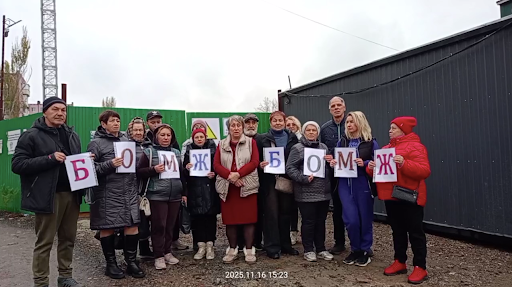 Residents of several demolished buildings in Mariupol are holding up signs “HOMELESS” in a video appeal to Putin. Screenshot from Telegram / 'Mariupol is us'
In the weeks leading up to Vladimir Putin’s annual ‘Direct Line’ on December 19 — a tightly controlled televised press conference that serves as a symbolic last resort for unresolved grievances — residents of Russian-occupied Mariupol have begun recording video appeals en masse. Nearly 4 years after Russia captured the Ukrainian southern port city in the spring of 2022, many say this ritualized appeal to the president is the only channel left through which they can hope to be noticed.
‘Dear Vladimir Vladimirovich! Until 2022, we had a happy, secure retirement. In 2022, we were out of luck. Four shells hit our house. We were left with nothing. We live wherever and however we can. When you visited our city and promised everyone comfortable housing in our neighborhood, equivalent to what we had before, we had hope. But almost four years have passed, and things have not improved. Mortgage housing is being built right before the eyes of 10.000 destitute, homeless Mariupol residents. Why aren't we, Russians, citizens of Russia, entitled to subsidized housing?’, says 74-year-old Galina Migovskaya from Mariupol in a video appeal to Putin.
In the videos circulating on social media, people stand in front of construction pits where their homes once stood, or beside newly built apartment blocks erected on the sites of their destroyed buildings — housing that, as they repeatedly emphasize, was not built for them. Their message is strikingly consistent: despite repeated promises by Russian authorities to restore housing destroyed during the siege of Mariupol, thousands of residents remain displaced. They are living with relatives, staying in summer houses, or renting apartments themselves. According to the residents, most of them have received neither financial compensation nor replacement housing.
Metallurgiv Avenue
One of the most common and illustrative cases comes from former residents of an apartment building at 133A Metallurgiv Avenue. Their home was demolished in 2023 by order of the authorities of the ‘Donetsk People’s Republic’. Residents say they were promised replacement housing as compensation — apartments to be built on the site of their destroyed building. Instead, construction began on a mortgage-funded residential project. In a video appeal addressed to Vladimir Putin, the residents accuse law enforcement agencies and courts of siding not with those who lost their homes, but with developers and local authorities.
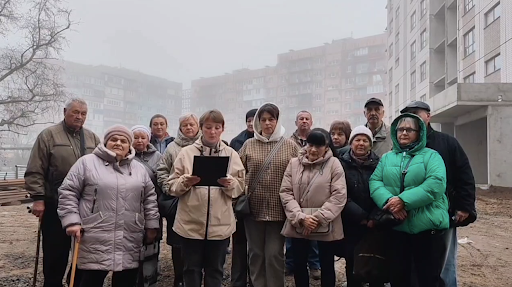 Screenshot from the video appeal to Putin from the residents of 133A Metallurgiv Avenue. Source: Telegram / 'Mariupol is us'
‘Vladimir Vladimirovich, only you can restore order in the territory of the Donetsk People’s Republic. Save the residents of Mariupol. All appeals to the prosecutor’s office, the Investigative Committee, and even the courts take the side not of those affected, but of big business', the residents say. According to them, officials have reported that former owners were offered to own between 2 and 5 percent of the apartments in mortgage-funded buildings. ‘This is not true’, the residents insist. ‘We are not given apartments — neither in these buildings nor elsewhere. We have simply been thrown out onto the street.’
Address annulled
After the demolition, residents say, the authorities annulled the building’s official address and assigned a new one to the site. As a result, the address listed in their ownership documents no longer exists in municipal and cadastral registries. ‘By annulling the address, they made us homeless’, they say.
'We have simply been thrown out onto the street’
By using this bureaucratic trick, the occupation authorities are clearing land for new developments. On the same plots, new apartment buildings are constructed under new addresses and sold through mortgage programs.
The same happened to residents of apartment blocks at 130 and 130A Artema Street, whose homes were demolished and replaced with new residential buildings. Instead of receiving replacement apartments, former owners were offered to buy back what they once owned, with a mortgage.
By early 2025, the program for constructing so-called ‘compensation housing’ in Mariupol had already been declared complete, despite thousands of unresolved cases. In February 2025, the Russian-installed local administration reported that around 10,500 residents in the city still required replacement housing. Mariupol’s occupation head, Oleg Morgun, said the housing deficit would be addressed through the creation of a municipal housing fund. According to him, the fund would be filled with apartments taken from properties that courts recognize as ‘ownerless’.
In an appeal to Vladimir Putin, residents of demolished buildings at 86 and 88 Lenin Avenue — where mortgage-funded developments are now under construction — accused officials of misleading the president.
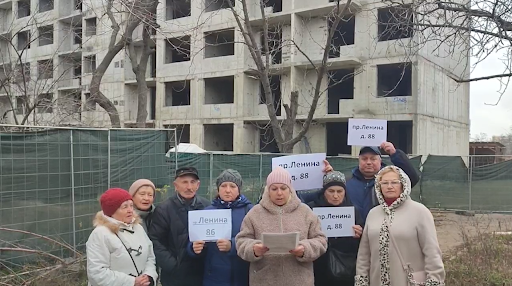 Screenshot from the video appeal to Putin from the residents of 86 and 88 Lenin Avenue. Source: Telegram / 'Mariupol is us'
‘In 2022, you said that all residents would receive housing on the sites of their demolished homes. Today is December 7, 2025, and we are still moving from one rented apartment to another, because officials reported to you that all Mariupol residents have been provided with housing', the residents said. ‘You were fooled. Only about 15 percent of residents have received housing. We understand the difficult situation in the country, but it does not prevent developers from building mortgage housing on the sites of our demolished homes, profiting from our tragedy. We ask you to restore the compensation housing program and stop the housing lawlessness in our city.’
‘A house by the sea’ for ‘mainland Russians’
Since 2022, Russian state-owned media regularly showcased newly built neighborhoods as proof that the city had been ‘restored’. Yet much of this housing was never intended as replacement for those who lost their homes. Instead, new apartment blocks were brought to the market as mortgage-funded developments. These apartments are priced far beyond the reach of most local residents, many of whom lost their livelihoods during the siege and occupation.
One of the clearest examples of how Mariupol is being rebuilt for others can be found in the city center, on Metallurgiv Avenue. On the site of a demolished residential building at number 77, construction is underway on a new development called Leningradsky Kvartal.
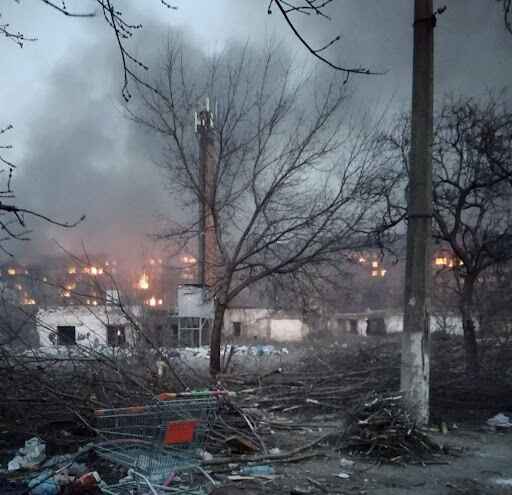 77 Metallurgiv Avenue during the siege of Mariupol. Photo from a local resident.
On the developer’s website, buying an apartment in the complex through a mortgage is described as 'a step into a happy future'. It remains unclear to whose future this refers. The website is already available in seven languages, and apartments in the complex are actively advertised on Russian real estate platforms outside of the occupied territories.
Financing construction
As covered in an investigation by ASTRA, the project is financed by Promsvyazbank — the first Russian bank to begin operating in occupied Ukrainian territories. This bank has been given control over virtually all residential construction in Mariupol, as well as the former central banks of the so-called Donetsk and Luhansk People's Republics (often referred to by their Russian acronyms 'DNR' and 'LNR'). In early 2024, it became known that Promsvyazbank had issued more than 200 mortgage loans worth nearly 1 billion rubles (around 10.6 million euros according to current exchange rates) for the purchase of apartments in Mariupol.
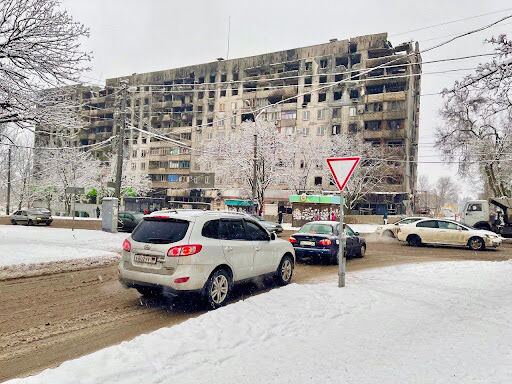 77 Metallurgiv Avenue during the Russian occupation. Photo from a local resident.
The developer behind the new housing complex Leningradsky Kvartal is the construction company SU-2007. Since the summer of 2022, it has been headed by Sergey Kuts, a former minister of construction of Russia’s Rostov region. Before that, Kuts spent eight years leading the capital construction directorate of Russia’s Southern Military District — a structure of the Ministry of Defense.
The construction company SU-2007 is owned by Alexander Zentsev, a businessman from Krasnodar who is under Ukrainian sanctions. Zentsev is a co-owner of the Neftermash plant and a beneficiary of several other companies in southern Russia. In 2025, he also became the owner of a major regional energy supplier, Yugstroy-Energosbyt, previously controlled by a prominent Russian banker.
For former residents of the demolished building on Metallurgiv Avenue, the appearance of Leningradsky Kvartal is not a sign of recovery, but of exclusion.
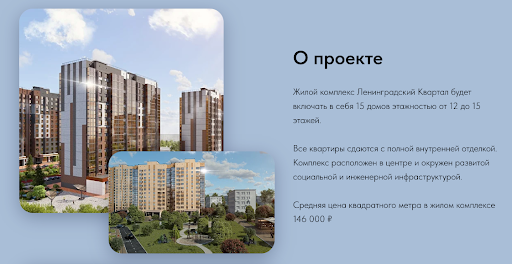 Advertising of the new residential complex 'Leningradsky Kvartal' built on the site of a demolished building, where apartments are sold through mortgage programs. Photo: Leningradsky Kvartal website
‘Who is this housing being built for?’, asks Olga, a former resident of building No. 77. ‘Our apartments are advertised on Russian websites, in St. Petersburg and other cities. Apparently, that’s who buys them. In Mariupol, it’s simply impossible to buy an apartment for 8 million rubles (just under 85,000 euros) with the compensation you might receive.’
Her neighbor Anna points to another barrier: eligibility itself. ‘Even to qualify for a mortgage, you need to be under 35 years old and have a stable income. In Mariupol, official salaries are around 20,000–22,000 rubles [around 200 euros] a month', she says.
As a result, mortgage-funded developments like Leningradsky Kvartal are consistently inaccessible to most of the city’s former residents. Built on the ruins of destroyed homes, they are instead marketed to buyers from mainland Russia.
‘Ownerless’ homes: legalized expropriation
What residents in Mariupol describe as ‘housing lawlessness’ is increasingly being formalized at the federal level. In Russia, lawmakers are now moving to legalize the mass seizure of property in occupied Ukrainian territories under the label of ‘ownerless housing’.
In December 2025, the Russian State Duma adopted a law that expands and legalizes the transfer of residential buildings, apartments, and rooms in Russian-occupied Donetsk, Luhansk, Kherson, and Zaporizhzhia regions of Ukraine to state ownership if they are deemed ‘ownerless’.
10 jaar RAAM: wij hebben uw hulp nodig
In 2026 bestaat RAAM 10 jaar. Het is geen vanzelfsprekendheid dat we blijven voortbestaan. Daarvoor hebben we uw hulp nodig. Met uw giften kunnen wij auteurs een bescheiden honorarium betalen, onderzoek doen en Kennisplatform RAAM overeind houden. Wij zijn een ANBI: uw gift is aftrekbaar van de belasting.
Under the proposed rules, housing can be declared ‘ownerless’ if the owner is unable to present what authorities consider valid documents, or if the owner cannot be identified. In practice, this includes people who fled during the invasion, those who cannot return in person, or those whose Ukrainian ownership documents are no longer recognized by the occupation authorities.
Lawmakers are moving to legalize the mass seizure of property
The bill is designed to formalize a process that has already been taking place on a mass scale in Mariupol and other occupied cities. Once transferred into state ownership, these apartments are to be redistributed to those who were left without housing after the siege — as well as to officials, military personnel, police officers, teachers, doctors, and other state employees.
By August 2025, Russian authorities had already identified more than 550,000 such ‘ownerless’ properties, according to data from Rosreestr.
In Mariupol, the construction of new housing for residents who lost their homes has already been officially completed. With no new compensation housing planned, local authorities are now openly proposing to resettle displaced residents into apartments classified as ‘ownerless’ — homes whose original owners either fled the city or were unable to confirm their ownership under the new rules.
In practice, however, even residents who never left Mariupol say their apartments have been added to ‘ownerless’ property lists.
'This is a raid-style takeover'
A pro-Russian activist Saniya Denisova, who documents housing seizures in the city, shared a notification received by a Mariupol resident who came to check on the restoration of her apartment on Fifty Years of October Boulevard. The document informed her that her apartment had been classified as ‘ownerless’.
Denisova describes the process as increasingly coercive. In one case on 133 Lenin Avenue, four men entered the building ahead of the daughter of a 70-year-old apartment owner and pressured the elderly woman into signing a statement acknowledging the apartment as municipal property — while her inheritance case was still pending. ‘This is no longer dealing with “ownerless property”’, Denisova says. ‘It is a real raid-style takeover, carried out through the intimidation of elderly residents. Officials from land departments are creating an atmosphere of fear and lawlessness.’
In another case previously reported by ASTRA, occupation authorities seized the apartment of a 90-year-old man whose home had been destroyed during the siege. His apartment in a rebuilt building was also declared ‘ownerless’ and transferred to the municipality.
Displaced Ukrainians are prevented from returning home
At the same time, thousands of Mariupol residents who fled the city during the siege are now unable to return — not because they refuse to, but because they are blocked from doing so.
Problems with so-called ‘filtration’ at Sheremetyevo Airport in Moscow have been documented since the early stages of the invasion. This 'filtration' is a security screening carried out by Russian border guards and the Federal Security Service. Those who fail to pass the screening are denied entry into Russia, sometimes without any formal explanation or written decision. In effect, this prevents many displaced residents from returning to their homes in occupied territories. Activists say that the number of refusals has increased sharply lately. While the real owners remain abroad, their homes in Mariupol are added to ‘ownerless’ property lists.
Previously, displaced residents could confirm ownership through a power of attorney. Now, the occupation authorities refuse to accept powers of attorney issued to Ukrainian citizens and require owners to appear in person — and only with a Russian passport.
One such case involves Elena, a pensioner with a disability from Mariupol. Her name has been changed for security reasons. She evacuated the city with her grandson in February 2022, during the first days of the siege. On the same day, her partner went to visit relatives on the city’s left bank but was unable to return because the bridge connecting the two sides was destroyed. Elena ended up in Poland, while her partner remained in the besieged city.
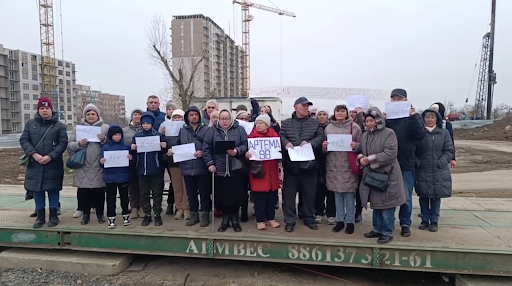 Residents of a building on Artema Street are recording an appeal to Putin with "SOS" posters. Photo: archive of local resident
In 2024, Elena attempted to return home. At the Russian border, she was denied entry without any explanation, she told ASTRA. While she remained abroad, her apartment in Mariupol was added to the list of ‘ownerless’ properties.
‘I just want to go home,’ Elena said. ‘I’m not young anymore. I had two heart surgeries in Poland. I can’t work, so I’m living with my daughter. A friend’s sister was traveling from Germany, and she wasn’t allowed in. My 35-year-old neighbor also tried, and he wasn’t allowed in either.’
Complaints from the pro-war community
Even figures within Russia’s pro-war Z-community have raised alarms. Some claim that even openly pro-Russian residents of Mariupol are being deliberately denied entry in order to clear the way for their property to be seized. According to pro-Kremlin propagandist and lawyer Tatyana Montyan, Mariupol has been used as a testing ground for a model that could later be applied across all occupied territories.
At the same time, appeals filed by Mariupol residents to prosecutors, investigators, and courts since 2022 are routinely forwarded back to local occupation authorities and left unanswered. ‘We submitted 150 complaints. There was no response', said Pavel Ivanov, a pro-war blogger who interviewed Montyan during a livestream.
With no functioning legal remedies and no independent courts, residents of occupied Mariupol say they no longer know where else to turn. Public protests are banned, and collective action in Putin’s Russia is impossible. As a result, video appeals to Putin recorded by former homeowners have become the only remaining way to draw attention to their situation.
That is why, year after year, ahead of Vladimir Putin’s ‘Direct Line,’ residents once again address the president directly. For many, it is not an expression of loyalty, but a last resort. These appeals have been recorded since 2022, throughout the fourth year of occupation. Yet despite the repetition — and the promises — the problem remains unresolved.
UPDATE - December 19
After this article was completed, residents of Mariupol who recorded video appeals to Vladimir Putin reported new forms of pressure. According to reporting by ASTRA, local occupation authorities have begun issuing warnings for alleged 'extremist activity' in connection with their appeals.
Some residents say they have been formally warned about violating Russia’s law on public assemblies, despite recording individual video messages. Others report being flagged by law enforcement and subjected to prolonged checks when crossing the border between 'DPR' and Russia. In addition, residents say authorities have effectively blocked their ability to submit appeals to Putin’s 'Direct Line' by disabling local postal services and interfering with SMS verification required to upload videos.
10 jaar RAAM: wij hebben uw hulp nodig
In 2026 bestaat RAAM 10 jaar. Het is geen vanzelfsprekendheid dat we blijven voortbestaan. Daarvoor hebben we uw hulp nodig. Met uw giften kunnen wij auteurs een bescheiden honorarium betalen, onderzoek doen en Kennisplatform RAAM overeind houden. Wij zijn een ANBI: uw gift is aftrekbaar van de belasting.