
The new United States National Security Strategy rattled many European capitals, but the response in Kyiv has been muted. Long accustomed to President Donald Trump’s erratic leadership, Ukraine is not easily startled. The document changes little about the country’s relationship with Washington, writes Vladyslav Faraponov, president of the Kyiv-based Institute of American Studies.
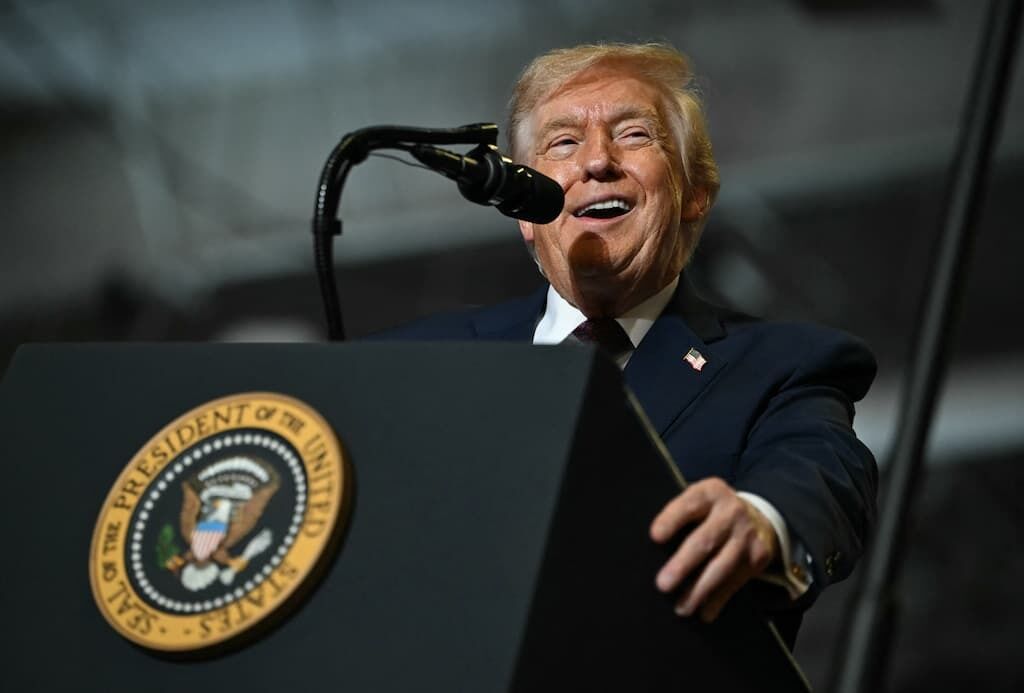 Photo: Andrew Caballero-Reynolds / ANP / AFP
The updated United States National Security Strategy sent shockwaves across Europe. Many politicians and experts were stunned by its blunt language and the degree to which it interferes in European internal affairs. Despite Russia waging a war of aggression on the continent, Europe and Ukraine can expect little sympathy; they – rather than Russia – are portrayed as the main problem.
Among other things, the document argues that Europe faces a ‘stark prospect of civilizational erasure’, the European Union ‘undermines political liberty and sovereignty’. ‘Should present trends continue, the continent will be unrecognizable in 20 years or less’, the document states. The US seek to ‘reestablish conditions of stability within Europe and strategic stability with Russia’, suggesting a focus on possible rapprochement with Moscow based on the normalization of trade relations.
Now in 2025, Trump’s idea of leveraging Russia through the promise of a distant return to ‘business as usual’, particularly in critical minerals and broader economic cooperation, is fundamentally flawed. Leverage cannot be built on the prospect of future trade with a state that systematically violates its commitments, as Russia has repeatedly demonstrated.
Ukraine, meanwhile, has grown accustomed to abrupt shifts in US policy, having endured more than a decade of fluctuating levels of American support.

Zigzag policy
In 2014, after Russia’s annexation of Crimea and the start of the war in the Donbas, Ukraine expected the US and the United Kingdom to uphold the security commitments made in 1994, when Kyiv signed the Budapest Memorandum under the first Clinton Administration and gave up its nuclear arsenal in exchange for security assurances. The reluctance to help Ukraine defend itself at the very outset of Russian aggression became one of the most significant turning points in European history since 1991.
President Trump likes to repeat that he provided Kyiv with highly accurate and lethal Javelin anti-tank missiles in late 2017, at a time when the conflict in eastern Ukraine was far less intense than the full-scale Russian war that began in 2022, while Obama, as he often claims, only ‘gave Ukraine sheets’.
Trump’s second term, however, has been much more unpredictable. Military support for Ukraine has been very limited at best, and the president’s boasting about the weapons he donated to Kyiv during his first run in the White House now stands in stark contrast to his push for Ukraine to agree to an unfavourable peace deal. President Zelensky does ‘not have the cards’ to win, as Trump has repeatedly said.
A win for Moscow
From Moscow’s perspective, the new United States National Security Strategy is a strategic win. The document fails to clearly identify Russia as hostile to US interests. It refers to Russia’s deliberate and unprovoked war of aggression against a sovereign nation merely as ‘the Ukraine war,’ a choice of words that subtly dilutes responsibility and normalizes aggression.
Another major problem with the National Security Strategy is that the Trump Administration does not acknowledge the interconnected nature of the threats posed by states such as China, Russia, and North Korea to the international order. If this reality remains unsaid, it will become harder for Ukraine to rally support for its cause and maintain strong and sustained Western support to safeguard Europe from Russia.
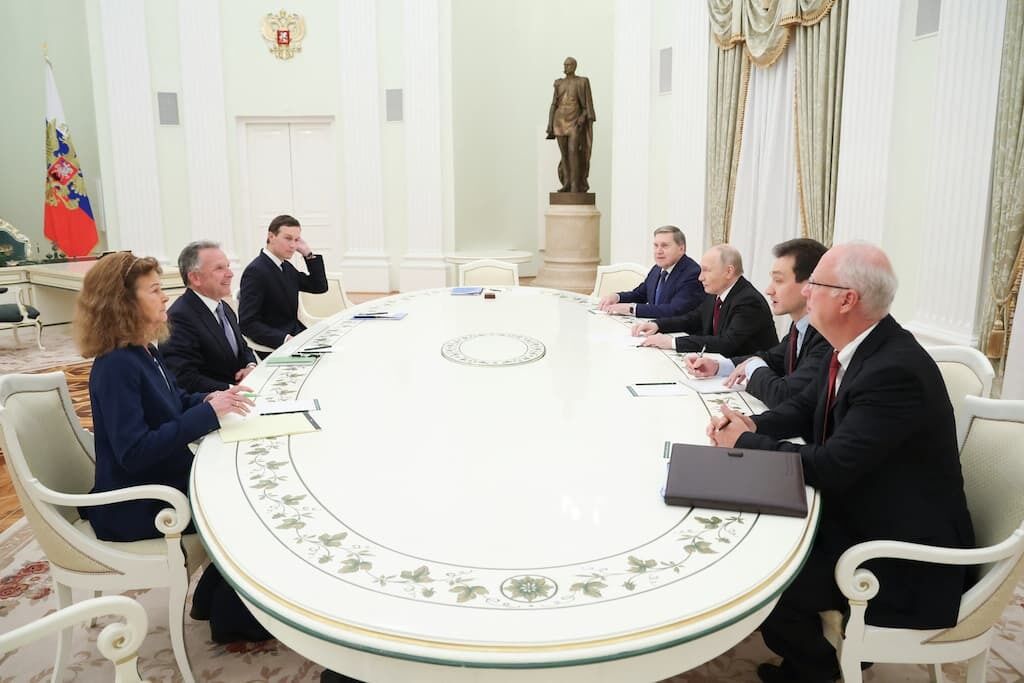 US special envoy Steve Witkoff and Donald Trump's son-in-law Jared Kushner meet with Vladimir Putin in Moscow on December 2, 2025. Photo: Alexander Kazakov ANP / AFP
It has already become more difficult for Ukraine to maintain American support. After a year in office, with Ukraine enduring fierce fighting and relentless bombardment, the Trump administration has yet to request additional funding from Congress for military assistance. Instead, Kyiv has introduced the Prioritised Ukraine Requirements List (PURL), a mechanism that allows NATO allies to purchase US weapons on Ukraine’s behalf.
Under the guise of ‘preparing’ for negotiations and signaling a readiness for peace, Russia has pushed Ukraine’s power grid to the brink of collapse, targeting not only major infrastructure but also small, decentralized generation networks. The result has been widespread and prolonged blackouts across the country.
Overall, the Security Strategy appears deliberately cautious, seemingly designed to avoid provoking Russia. The document states: ‘As a result of Russia’s war in Ukraine, relations between Europe and Russia are now deeply strained, and many Europeans regard Russia as an existential threat.’
The section on Russia’s war against Ukraine functions less as an indictment of Russian aggression than as a segue into criticism of European allies
Notably, the document frames Russia as a threat to Europe, yet stops short of describing it as a challenge to the US-led world order or to the United States itself. Even more striking is how the section on Russia’s war against Ukraine functions less as an indictment of Russian aggression than as a segue into criticism of European allies. The focus shifts away from Russia’s invasion, war crimes, and acts of genocide, and instead turns to accusations directed at Europe.
This turn against its allies is best exemplified by the following section: ‘The Trump Administration finds itself at odds with European officials who hold unrealistic expectations for the war, perched in unstable minority governments, many of which trample on basic principles of democracy to suppress opposition.’
Selective amnesia
In that context, what particularly troubles Ukrainians in Trump’s new National Security Strategy is its reference to ‘civilizational erasure,’ a term the White House uses to describe economic stagnation and the consequences of migration in Europe.
In reality, Russia is carrying out civilizational erasure in Ukraine by forcing people to flee their homes, pushing millions abroad, and condemning those who remain to live for 10 to 20 hours a day without electricity and under unlivable conditions. Yet, the Trump administration does not appear to recognize this as a threat to the very values the United States has long claimed to defend.
This selective amnesia also extends to promises Donald Trump made before his re-election, such as his pledge to provide Ukraine with military aid if Russia refused to end the war. Conversely, he warned that if Kyiv were unwilling to accept a deal, it would no longer receive military assistance from the United States.
Disproportionate pressure
Throughout 2025, pressure has fallen heavily on Ukraine, which feels compelled to accept any peace proposal put on the table, fearing that the next one might be worse. Meanwhile, Trump’s negotiating team – led by his special envoy Steve Witkoff and his son-in-law Jared Kushner – has repeatedly visited Russian dictator Vladimir Putin, even as Russia continues fighting over towns and cities that it is slowly reducing to rubble. According to the Institute for the Study of War, Moscow conquered less than 0.8% of Ukrainian territory in 2025 while suffering disproportionately high casualties.
At the core of Russia’s behavior lies a simple and consistent objective. Vladimir Putin is not seeking a negotiated peace; he is seeking to avoid defeat while preserving the possibility of imperial restoration.
Putin’s goal is not only to subjugate Ukraine, but to prevent its integration into the European Union and NATO and to reassert Russia’s sphere of influence across Europe. This logic has not changed since 2014, nor since 2022, nor in 2025. As long as Moscow believes it can extract concessions through pressure, coercion, and civilian suffering, it has no incentive to end the war. Any strategy that ignores this reality risks mistaking tactical pauses for peace and negotiations for resolution.
As long as Moscow believes it can extract concessions through pressure, coercion, and civilian suffering, it has no incentive to end the war
Western agendas continue to ignore a fundamental reality: allowing Russia to prevail in Ukraine would open the door to an expansion of Russian influence across Eastern Europe. Confronting Russia and denying it victory in Ukraine is therefore not optional – it is strategically imperative, not only to preserve European security but also to curb China’s global ambitions. Yet the new security strategy fails to acknowledge this linkage, revealing a dangerous blind spot in US strategic thinking. Only now, nearly a year after his inauguration and thousands of Ukrainian casualties later, Trump finally seems to consider extending security guarantees to Ukraine to prevent future aggression from Russia.
From this perspective, the only viable path toward a genuine ceasefire and lasting peace in Europe lies in exerting substantial pressure on Russia. A complementary component is sustained support for Ukraine, enabling Ukrainians to degrade Russian war-fighting capabilities themselves, should NATO members fear that direct involvement would be interpreted by Moscow as an act of war.
All in all, despite obvious inconsistencies and polar positions, Kyiv will continue to work with the Trump administration, not least because it has little choice. Past experience has taught Ukrainians not to be surprised when dealing with the United States. No one desires peace more than Ukrainians themselves, as they value freedom and the right to pursue happiness in their own country.
10 jaar RAAM: wij hebben uw hulp nodig
In 2026 bestaat RAAM 10 jaar. Het is geen vanzelfsprekendheid dat we blijven voortbestaan. Daarvoor hebben we uw hulp nodig. Met uw giften kunnen wij auteurs een bescheiden honorarium betalen, onderzoek doen en Kennisplatform RAAM overeind houden. Wij zijn een ANBI: uw gift is aftrekbaar van de belasting.