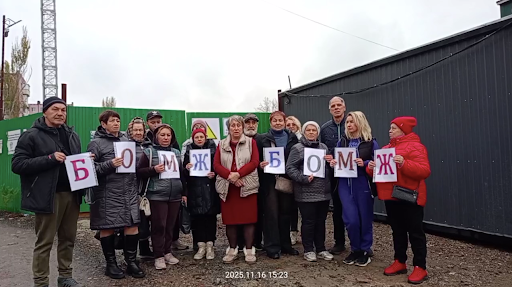

The small city of Kupiansk near Kharkiv has increasingly become one of the most contested and politically sensitive episodes of Russia’s war against Ukraine. The battle for the city is not only unfolding on the ground, but also being fought in statements, reports, and competing narratives. Investigative journalist Anna Snegireva reconstructs how the Kremlin claimed a victory it has never achieved.
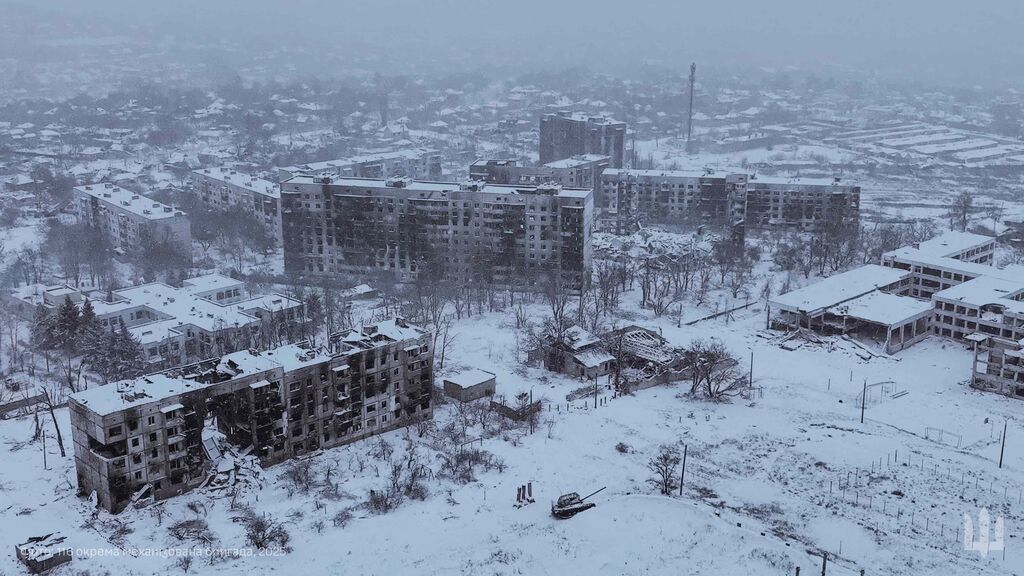 Aerial view of heavily damaged residential buildings in the frontline town of Kupiansk, Kharkiv region. Photo: ANP / Handout / 116th Separate Mechanized Brigade of the Ukrainian Ground Forces / AFP
This month, Russian pro-war bloggers reported that the last stronghold of Russian troops in Kupiansk, the Central District Hospital, had been destroyed. The remaining group of soldiers who were holding out in the hospital had been wiped out. It was a symbolic end to the Russian ‘capture’ of Kupiansk that, as it turns out, only ever existed on paper in the Kremlin’s narratives.
By the end of 2025, Kupiansk had become one of the most frequently cited cities along the front line — on both sides of the war. It was the scene of some of the most intense fighting between Ukrainian and Russian troops. Both strived for control over the strategically important city.
Why Kupiansk matters
Kupiansk is located in the eastern Kharkiv Oblast, near the Russian border, on the banks of the Oskil River. At first glance, it's a relatively small town. But in the logic of this war, its size is practically irrelevant because it serves as a very important transportation hub. The city lies at the intersection of key transport routes toward Kharkiv — Ukraine’s second-largest urban center and a key industrial and administrative hub in the northeast. This makes it a link between Russia and Ukraine's northeastern theater of military operations. Without Kupiansk, any attempt to support a large-scale offensive on Kharkiv becomes significantly more difficult.
This is why Kupiansk became strategically important from the very first stage of the full-scale invasion. When Russian forces captured it in 2022, they secured a logistical base for operations toward Izium and Lyman. When Ukrainian forces recaptured it later that year during the Kharkiv counteroffensive, the effect was equally structural: Russian supply chains in the area were disrupted, and the entire axis of attack had to be reconsidered.
Without Kupiansk, any attempt to support a large-scale offensive on Kharkiv becomes significantly more difficult
By mid-2025, Russian troops had again intensified pressure on the Kupiansk direction. According to the Ukrainian news website Babel and frontline mapping projects such as DeepState, Russian forces increasingly relied on infiltration tactics and small assault groups instead of large mechanized offensives. In some cases, Russian units reportedly used underground pipe networks to approach the city unnoticed.
Officially, the Kremlin has consistently presented its territorial objectives in terms of the annexed or partially occupied regions — primarily Donetsk and Luhansk, and later Kherson and Zaporizhzhia. Kharkiv Oblast has never been formally included in these claims. Yet battlefield dynamics do not always align with declared political goals. Even without formal annexation claims, control over border regions like Kupiansk can carry strategic value: it allows for pressure on adjacent areas, disrupts Ukrainian logistics, and creates buffer zones.
The battle for Kupiansk on the ‘media front’
On November 20, 2025, Valery Gerasimov reported to Vladimir Putin that Kupiansk had been captured. The claim was later echoed by Defense Minister Andrey Belousov, who congratulated Russian troops on the ‘liberation’ of the settlement. In late December, Andrey Kuzovlev, commander of Russia’s western military district, stated that Ukrainian forces in the city would be eliminated within weeks, by January or February.
Later, Vladimir Putin ceremonially awarded General Andrey Kuzovlev with Russia’s highest state distinction — the Hero of Russia star — at the Kremlin. It is possible that the award was tied to the claimed ‘capture’ of Kupiansk.
 Vladimir Putin presents the Hero of Russia medal to General Sergey Kuzovlev. Photo: Kremlin
Yet only weeks after Kuzovlev’s statements, even pro-war Russian bloggers began to acknowledge that the situation on the ground did not match the triumphant reports coming from the Ministry of Defense.
‘The reality differs from the optimistic reports of our respected sources’, wrote an influential pro-war Telegram channel, DONTSTOPWAR, in early December. The author described the situation in markedly different terms: ‘Despite claims of control, there is no real advance inside the city, and the frontline remains static. The main issue is critically difficult logistics — supplies are delivered mostly by air, as everywhere else, which is why fundraising for Mavics [drones used along the frontline] never stops.’
On the 12th of December, 2025, Ukrainian president Volodymyr Zelensky recorded a video near the entrance sign of Kupiansk to dispel the Russian narrative that the city was occupied.
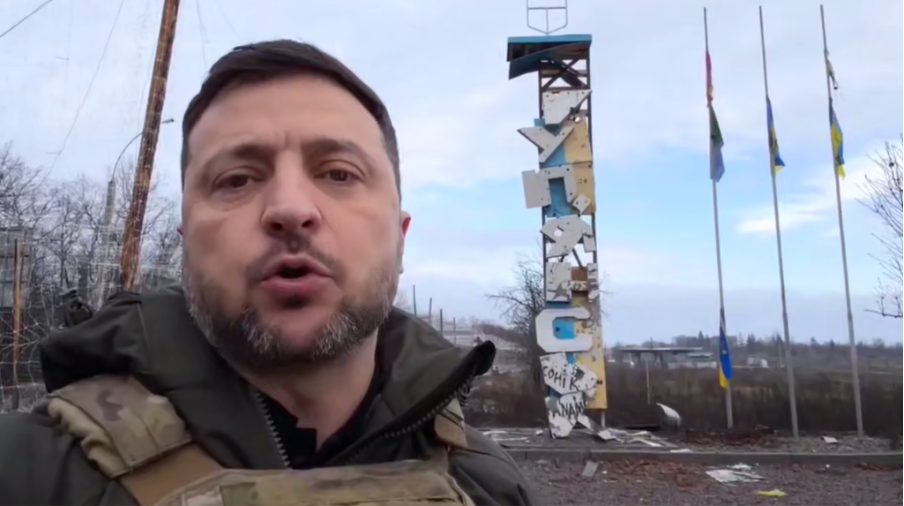 Screenshot from Zelensky’s video in Kupiansk.
Nevertheless, just five days later, Andrey Belousov once again reported that Kupiansk had been brought under Russian control: ‘The “West” group of forces has taken the strategically important city of Kupiansk, which the enemy is unsuccessfully attempting to retake.’
Later, Vladimir Putin responded to Zelensky’s video by saying: ‘The sign is located about a kilometer from the city itself. Why stand on the doorstep? Go inside the house, if Kupiansk is really under their control.’ Putin also referred to Volodymyr Zelensky as a ‘talented actor’. Within weeks, however, the disconnect between official triumphal reports and the situation on the ground was becoming difficult to ignore — even for pro-war Russian Telegram channels traditionally loyal to the Kremlin.
An influential Telegram-channel linked to the Russian ministry of Defense, Rybar, reported that the situation there was ‘worse than critical’. According to the channel, Russian troops had lost much of their foothold on the western bank of the Oskil River. Rybar also claimed that one Russian unit lost nearly 150 soldiers near a village that had officially been declared ‘liberated’ weeks earlier. More notably, the channel directly blamed false reporting inside the Russian command structure: ‘Systematic exaggeration of successes and the transmission of inaccurate information upward have already resulted in false statements being made at the highest possible level.’
10 jaar RAAM: wij hebben uw hulp nodig
In 2026 bestaat RAAM 10 jaar. Het is geen vanzelfsprekendheid dat we blijven voortbestaan. Daarvoor hebben we uw hulp nodig. Met uw giften kunnen wij auteurs een bescheiden honorarium betalen, onderzoek doen en Kennisplatform RAAM overeind houden. Wij zijn een ANBI: uw gift is aftrekbaar van de belasting.
The Russian military blog Voenny Osvedomitel (War Informant) remarked that Russian forces had ‘already lost almost the entire territory of Kupiansk’, adding that staged videos and claims about a ‘fake Zelensky video’ near the city entrance had failed to change the battlefield reality. It concluded with a sarcastic jab: ‘At least everyone got their medals’. Perhaps the bluntest summary came from pro-war blogger Anatoly Radov: ‘Kupiansk is lost. Restoration work is underway.’
Soon afterward, the Russian Ministry of Defense once again declared full control over Kupiansk. In an attempt to support its statements, the ministry released footage purportedly showing Russian troops operating inside the city. Yet military bloggers quickly pointed out an awkward detail: the soldiers in the video appeared to be moving not deeper into Kupiansk, but toward the exit from the city.
One pro-war Telegram channel, ‘Group of Forces ZAPAD’, reacted with open frustration: ‘The most interesting part is that the soldiers are moving toward the EXIT from the city. They have just a few houses left — and that’s it. The exit. From. The. City. Is being used as proof of control over the situation in the city. Mysterious are the ways of this sacred anti-crisis PR campaign. Forgive the blasphemy, but otherwise only obscenities come to mind.’
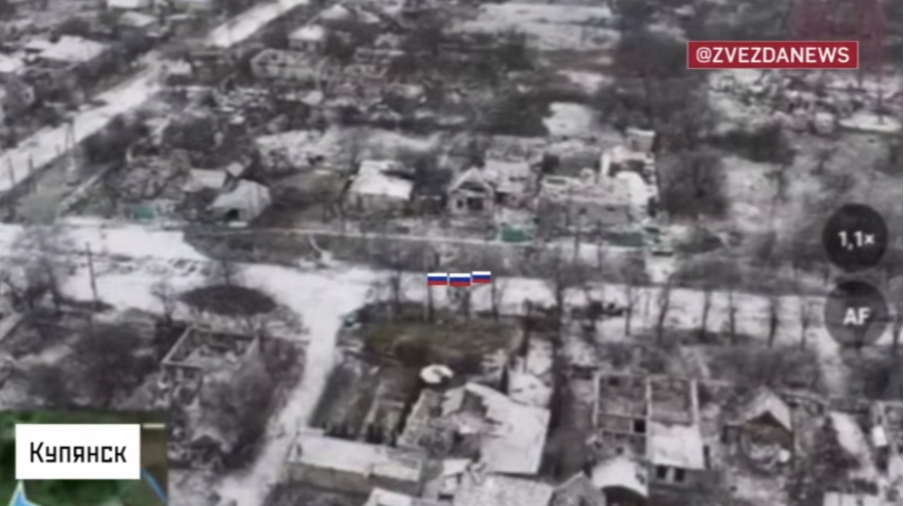 Screenshot from the Russian Ministry of Defense's official TV-channel 'Zvezda'. Photo: The Insider
The last Russian stronghold in Kupiansk
Only in May 2026 did Russian pro-war channels report on the fate of the soldiers who had recorded staged ‘reporting’ footage for the Ministry of Defence — videos with Russian flags that were used as evidence of the city’s ‘liberation’ while official statements declared control over Kupiansk to the outside world. In the video, one of the soldiers standing among the ruins states that Kupiansk had been ‘heroically taken’.
According to multiple Z-channels, a group of Russian assault troops – who appeared on the video – found themselves isolated inside the Central District Hospital in Kupiansk — a location that, at least on paper, was already under Russian control following earlier official declarations.
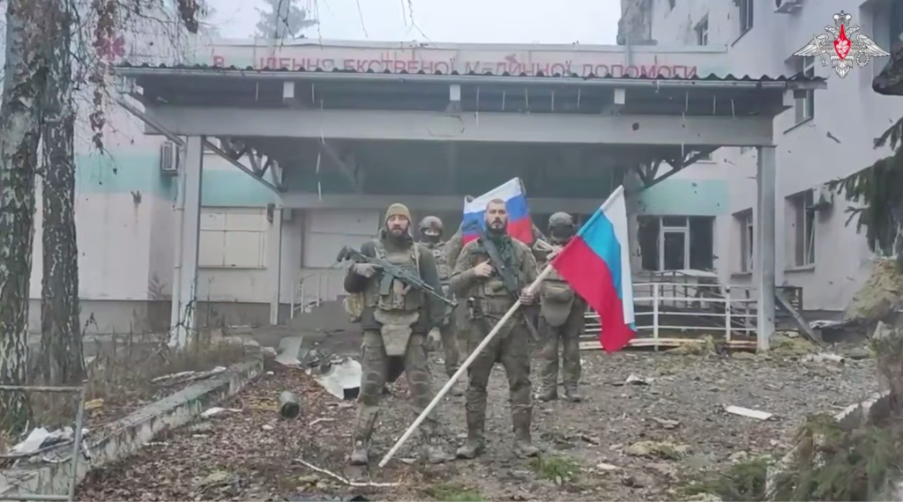 Screenshot from video of the Russian Ministry of Defence.
The channel Pioneer Reserve published images of the stranded soldiers, claiming they had been holding out in the hospital for almost 6 months. The author wrote about shortages of water and supplies, improvised survival conditions, and continuous fighting around the building. One channel noted that the soldiers were forced to melt snow and ice for drinking water due to lack of resupply.
The contradiction became impossible to ignore. As the Z-channel ‘Romanov Lite’ put it, the situation inside Kupiansk was being described as ‘fully controlled’ in official reports, while in reality parts of the city were still contested or inaccessible even to Russian units.
Ukrainian forces, including elements of the National Guard’s ‘Khartia’ Corps, simultaneously published footage of clearing operations in the city, reinforcing the picture of an active, unresolved urban battle rather than consolidated control.
In spring 2026, Z-channels reported that the hospital — described as a last stronghold for a trapped Russian group — was heavily damaged and eventually destroyed amid sustained fighting and strikes. While some sources claimed that surviving soldiers were evacuated or had withdrawn, others stated that the group had been effectively wiped out during the collapse of their position.
 Some of the last Russian soldiers in Kupiansk. Photo: Telegram / Pioner Zapasa
Later it turned out that the soldier allegedly involved in filming earlier ‘control’ footage with a Russian flag was later reported killed after spending months in the besieged hospital position. Z-channel Romanov Lite wrote that this footage effectively ‘earned’ the previously mentioned Commander of the western military district Sergey Kuzovlev an undeserved Hero of Russia star.
The same source described the fate of the soldier who filmed the video in Kupiansk: ‘In full encirclement, he defended the Central District Hospital. He spent half a year in Kupiansk without rotation or evacuation due to a personal conflict with his regiment commander. While completely surrounded, he did not surrender (unlike a neighbouring group in the church) and held out to the end. After the hospital was completely destroyed by enemy fire, he and his group remained in the basement and continued to repel assaults. He was killed in action and later declared missing.’
What's happening in Kupiansk now?
According to the map below, by the Ukrainian OSINT project DeepState, Kupiansk remains in a so-called ‘gray zone’, where active fighting continues and control is fragmented.
During the three-day ceasefire from 9 to 11 May announced by Donald Trump, Russian military Telegram channels reported that on the Kupiansk sector — described as one of the most intense and bloody parts of the front — both sides allegedly agreed not to interfere with search-and-recovery teams retrieving bodies from the battlefield.
At the same time, Ukrainian sources reported the evacuation of the last remaining civilians from Kupiansk — mainly elderly residents and people with limited mobility — as the security situation in the city continued to deteriorate and frontline fighting persisted around the urban area.