The Strait of Hormuz has demonstrated how a regional crisis can alter the strategic economy of Ukraine’s war. Energy prices, Russian revenues, supply chains, defense-industrial scarcity, U.S. and NATO allocation choices, and Ukraine’s own battlefield innovation now interact across theaters, argue Oleksandra Moskalenko, Professor in Economics at the Kyiv National Economic University, and U.S. Army veteran Clemente Berrios, Jr.
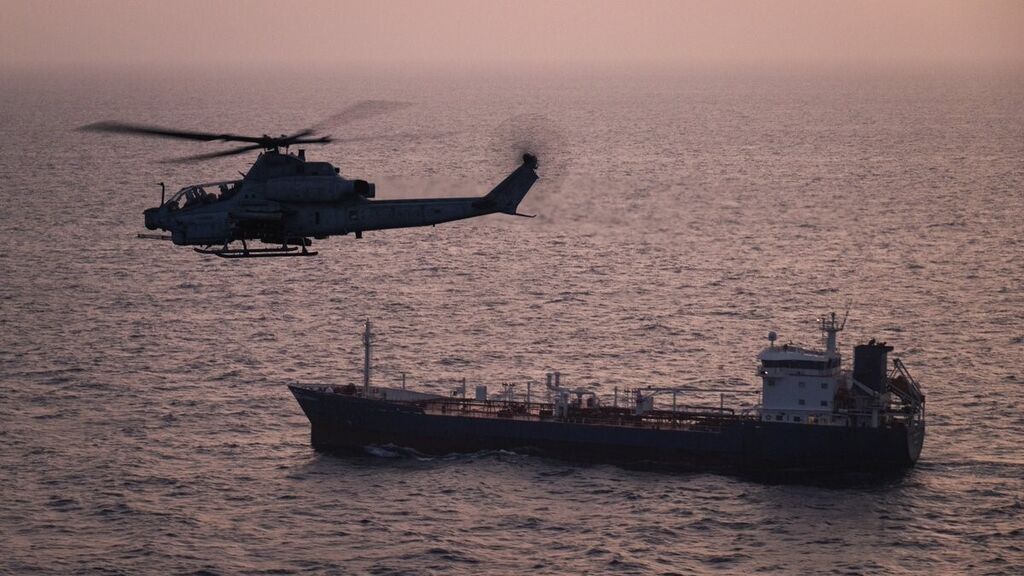 A US Marine Corps attack helicopter patrols near a commercial vessel transiting regional waters as American forces enforce the maritime blockade against Iran. Photo: CENTCOM / X
The Strait of Hormuz, a maritime chokepoint 3,500 kilometers from Kyiv, has quietly shaped the conditions under which Ukraine can sustain its war against Russia. The crisis affects the conditions under which Ukraine fights, not through missiles or soldiers, but through oil prices, strained defense budgets, and competition for the same weapons systems Ukraine depends on for its survival.
Modern wars are heavily affected by energy markets, shipping lanes, insurance premiums, sanctions regimes, defense factories, public budgets, and political attention. All of these are changing due to the current crisis in the Middle East. Hormuz makes this reality visible. It links the Persian Gulf to the Gulf of Oman and the wider Indian Ocean. In 2024, the Strait carried about 20 million barrels of oil per day, more than one-quarter of global seaborne oil trade and roughly one-fifth of world petroleum liquids consumption. It also carried around one-fifth of global LNG trade, primarily from Qatar. Saudi Arabia, Iraq, the United Arab Emirates, Kuwait, and Qatar depend heavily on this route; Asia absorbs most flows, especially China, India, Japan, and South Korea.
Hormuz in numbers
~20 million barrels/day transit the strait
>25% of global seaborne oil trade
~20% of global petroleum liquids consumption
~20% of global LNG trade
Main importers: China, India, Japan, South Korea
Source: EIA (2025)
That concentration means that the effects of a blockade of Hormuz does not stay local. The graph below illustrates how price volatility in this period has already reflected geopolitical risk.

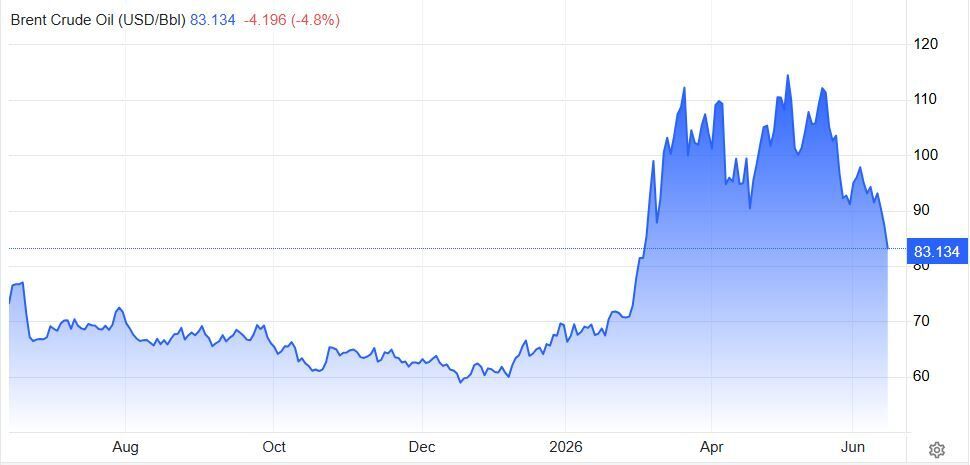 Brent Crude Oil Price Dynamics, July 2025–June 2026. Source: Trading Economics
Price volatility matters because it affects inflation, fiscal capacity, and the economic conditions under which Ukraine and its partners sustain long wars.
For Ukraine, the significance is indirect but real. It is fighting Russia on the battlefield, but also inside a global economic environment that either sustains or erodes its capacity to resist. When energy costs rise, European governments face pressure to protect households and industry. When budgets tighten, long-term support for Ukraine becomes harder to maintain politically. When several crises demand attention at once, political attention and industrial capacity turn out to be finite. Therefore, in military terms, Hormuz affects the rear area of Ukraine’s war.
How a Gulf crisis reaches Moscow
But this does not only apply to Ukraine. Russia also experiences the fallout of the closure of Hormuz, albeit for different reasons. Russia remains a major energy exporter, with oil and gas revenues supplying roughly one-quarter to one-third of federal budget revenues in recent years. Since 2022, sanctions, price caps, insurance restrictions, and Ukrainian strikes have complicated Moscow’s ability to convert oil into military spending power. However, sanctions have redirected rather than eliminated demand: India and China became the dominant destinations for Russian crude after 2022. Higher global oil prices can therefore still improve Russia’s fiscal position.
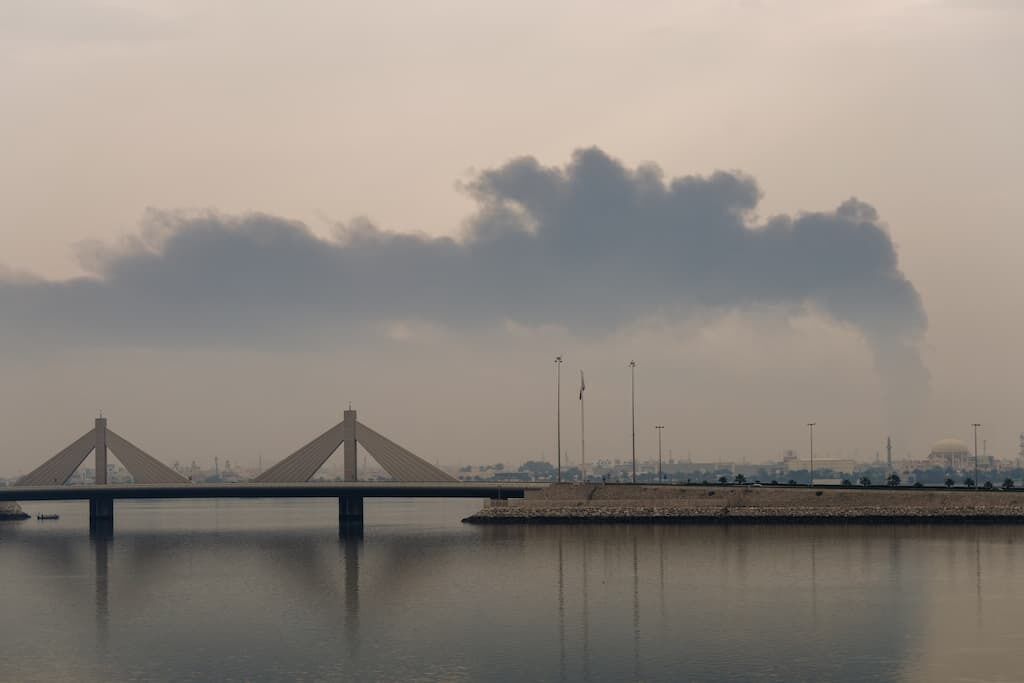 A plume of smoke rises after a reported Iranian strike on fuel tanks in Muharraq, Bahrain, on March 12, 2026. Photo: ANP / Fadhel MADHAN / AFP
That is the strategic problem. Europe can sanction Russia, Ukraine can strike Russian oil infrastructure, and the West can restrict Moscow’s access to technology and finance. Yet a major shock in the Gulf can raise the value of Russian energy exports, partially offsetting the impact of sanctions. This tension became visible in March 2026, when the United States issued a temporary waiver for certain Russian oil cargoes stranded at sea, showing how energy stabilization can compete with sanctions enforcement. If Hormuz tightens supply, Russian barrels become more valuable. If Moscow gains fiscal space, Ukraine faces a more durable adversary with greater capacity to sustain a prolonged war.
Sanctions operate inside markets which react to fear, scarcity, war, and uncertainty. While battlefield momentum may dominate in a short war, endurance is the key to winning a long war. And endurance depends on ammunition, manpower, energy, industry, money, social cohesion, and political will.
The main transmission channels linking a Hormuz shock to Ukraine are summarized below.
|
Mechanism |
Immediate Effect |
Strategic Consequence for Ukraine |
|
Oil-market disruption |
Higher prices and volatility |
Potential increase in Russian energy revenues |
|
Shipping and insurance risk |
Higher transport and trade costs |
Greater pressure on European economies |
|
Inflation and fiscal pressure |
More domestic budget strain |
Ukraine support becomes more politically contested |
|
Defense-industrial scarcity |
Competition for air defense, interceptors, drones, and munitions |
Slower or harder replenishment for Ukraine |
|
Political attention |
Multiple crises compete for leadership bandwidth |
Ukraine risks becoming one priority among many |
|
Ukrainian drone expertise |
Gulf states seek counter-drone lessons |
Ukraine becomes a producer, not only a recipient, of security knowledge |
Competing for available weapons
Another mechanism tied to the war in Iran deserves more attention in European policy circles: defense-industrial scarcity. Ukraine’s survival depends on air defense, interceptors, artillery, drones, electronic warfare, and long-range strike capability. None of these are unlimited. They depend on production lines, skilled labor, components, contracts, and political decisions made in Washington, Brussels, and other European capitals.
When war in the Middle East escalates, demand for many of the same systems rises. States protecting bases, ports, energy infrastructure, and shipping routes draw from the same global inventories. The Patriot allocation debates of the past two years, persistent NATO ammunition shortfalls, and the push to expand European production capacity all reflect the same underlying reality: the arsenal is not infinite.
A Patriot interceptor sent to one theater cannot be fired in another. A production line expanded for Ukraine cannot instantly satisfy every simultaneous crisis. A stockpile depleted today may not be restored for years. This is not an abstract planning problem but the operational reality that commanders and ministers face when crises overlap. When they have to choose, those choices reveal priorities.
A Patriot interceptor sent to one place cannot be fired in another, a production line expanded for Ukraine cannot instantly satisfy every simultaneous crisis, and a stockpile depleted today may not be restored for years
Supply chains connect this scarcity to the wider economy. Because more than a quarter of global seaborne oil trade passes through Hormuz, disruption there quickly raises shipping costs and insurance premiums, slows the movement of industrial inputs, and increases costs for the energy-intensive manufacturing that underpins defence production: missiles, drones, vehicles, electronics, explosives. Supply chain stress becomes military readiness stress.
How Ukraine changes security beyond Europe
The relationship runs in both directions. Ukraine’s more than four years of fighting Russian missiles and Iranian-designed drones have produced one of the world’s most adaptive drone and counter-drone ecosystems. The war forced rapid innovation: acoustic detection systems, low-cost interceptors, electronic warfare, decentralised manufacturing, and battlefield feedback loops that compress the cycle between problem and solution to days rather than months.
That experience is now relevant to the Middle East. Ukraine’s battlefield knowledge can help other states defend against drone swarms, protect infrastructure, adapt procurement, and accelerate defense innovation. This does not mean Ukraine is 'interfering' in the Middle East in the old political sense. It means Ukraine’s war has generated capabilities, tactics, and security knowledge that other regions now need. Ukraine is not merely a beneficiary of European security. It is increasingly a contributor to it.
These interactions are not linear. They form a broader system, part of an interconnected chain, in which energy markets, defence industries, political attention, and battlefield knowledge flow between theaters in ways that traditional regional security analysis tends to miss.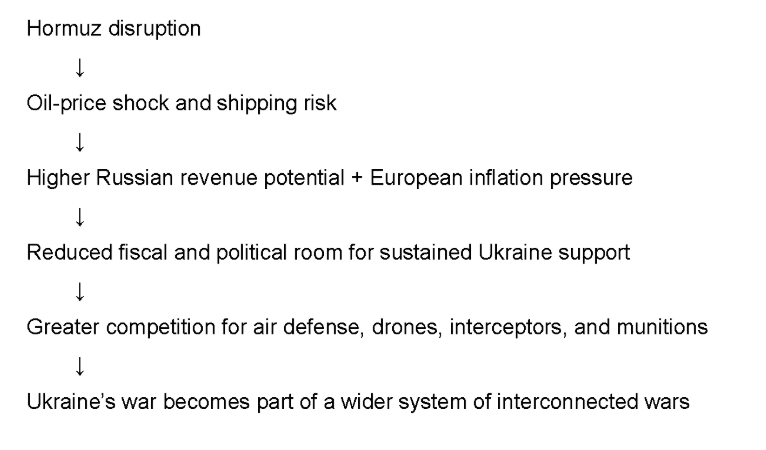
Ukraine is no longer a standalone European war
This is the age of interconnected wars: energy markets transmit military shocks, supply chains transmit strategic vulnerability, financial flows transmit sanctions pressure and sanctions evasion, defense industries transmit scarcity, political attention becomes a finite resource, policymakers can no longer separate regional crises into neat files: Ukraine here, Iran there, shipping somewhere else, inflation in another ministry, defense procurement in another committee. That separation is analytically convenient and strategically dangerous.
For Europe, the conclusion is blunt. Supporting Ukraine is not an act of regional generosity. It is a test of whether Europe can defend its political order under cumulative pressure. The answer will not come only from speeches. It will come from energy resilience, industrial production, financial stamina, sanctions enforcement, maritime security, and public honesty about cost.
For Europe, supporting Ukraine is a test of whether it can defend its political order under cumulative pressure
The war in Ukraine can no longer be understood as a standalone European conflict. The interconnected system now includes Russia as initiator of the war in Europe, Iran as military and regional actor, the United States as strategic balancer across multiple theaters, NATO as the coordination architecture, European states as fiscal and political supporters under growing domestic pressure, and Ukraine as both the main recipient and increasingly important producer of security.
The Gulf does not need to become a Ukrainian battlefield to shape Ukraine’s war. It already shapes the conditions under which Ukraine, Europe, and Russia calculate endurance. Ukraine has paid the highest price to teach Europe this lesson. Hormuz shows that the lesson is global.
10 jaar RAAM: wij hebben uw hulp nodig
In 2026 bestaat RAAM 10 jaar. Het is geen vanzelfsprekendheid dat we blijven voortbestaan. Daarvoor hebben we uw hulp nodig. Met uw giften kunnen wij auteurs een bescheiden honorarium betalen, onderzoek doen en Kennisplatform RAAM overeind houden. Wij zijn een ANBI: uw gift is aftrekbaar van de belasting.