

This week, Ukraine celebrated its 35th Independence Day. While Ukraine continues to defend itself against Russian aggression, in the background the political system continues to be plagued by corruption. In his latest column, Mykola Riabchuk explains that while Ukraine has demonstrated significant progress in some areas, its institutions remain underdeveloped.
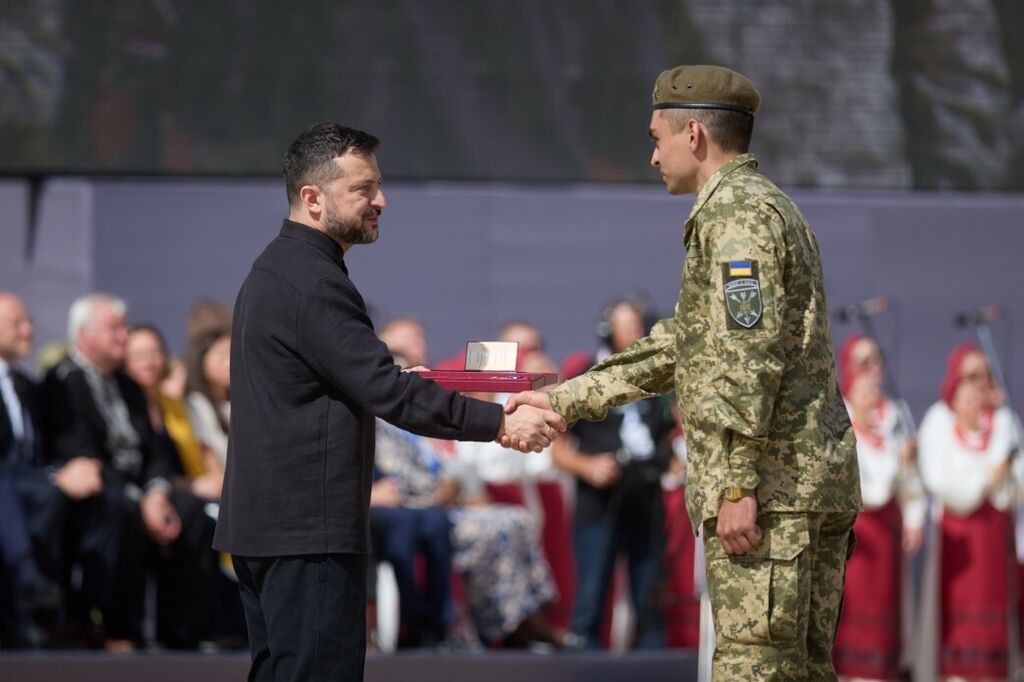 Zelensky awards medals on Independence Day in Kyiv, 2026. Photo: Office of the President of Ukraine
‘Finally we can sleep peacefully for a night, without air raid alerts and explosions’, is how many Kyiv residents half-jokingly summed up the results of the latest visit by a large group of European leaders to the city, on the occasion of Ukraine’s Independence Day.
The fact that Moscow paused its heavy drone and missile attacks on Kyiv – which had been going on almost incessantly since Trump’s return to power – for two days is probably no indication of Putin's goodwill, but rather the result of a sober political calculation: not to give Ukrainians additional arguments in their tough negotiations with Western partners over the scale and pace of military support.
'Finally we can sleep peacefully for a night'
Ukraine’s arguments are not unknown or disputed, but they may be received differently in relatively peaceful moments, than amid ferocious air attacks that the visitors experience firsthand, potentially resulting in a more emotional response. And even Moscow has a limited number of drones and missiles. By giving Kyiv a few days’ exemption, the Russians simply freed up ‘resources’ to attack Kharkiv, Odesa, and Zaporizhzhia.
The most obvious reason for top European officials to visit the capital on Ukraine’s national holiday was to demonstrate their solidarity with the beleaguered nation, ruthlessly terrorized by a neighboring rogue state and losing at least a dozen civilians across the country every day. The gesture, as well as the emphasis on the unwavering support for Ukraine’s sovereignty, were of great importance: national independence is recognized as a core value by most citizens, and Independence Day is now considered the country’s third most popular holiday (after Easter and Christmas). That is a dramatic shift from 2013 – before the Euromaidan and the Russian invasion – when only 12% of respondents considered it important.
Coalition of the Willing
The symbolism of the day notwithstanding, there was perhaps a less obvious but more daunting reason for the visit: another summit of the 34-member ‘Coalition of the Willing’ (partly represented by their leaders via video connection). The coalition urgently wants to find a means of countering Russian ballistic missiles that freely penetrate Ukrainian skies in the absence of effective interceptors. These interceptors – missiles for the Patriot antiballistic systems – were provided by the United States until this year, but deliveries have halted (even though they were already paid for by the EU) because the Americans have arguably depleted their arsenals in their reckless and largely pointless Middle East ‘operation’. While the Brits still hope to persuade President Trump to resume ‘Patriot’ deliveries, or even to license Ukraine to produce them domestically, Ukraine is pushing ahead with a more feasible solution: getting more weapons for long-distance strikes from its partners, to disable Russian missiles at their production and launch sites.
That shift seems reasonable. Russia has already ramped up production of ballistic missiles, and no global producer can currently counterbalance that output with the production of interceptors. Preventive strikes on Russian missile producers and launch sites, along with tougher sanctions on the import of electronic components for these missiles, might really be a better solution than searching for expensive and scarce Patriots.
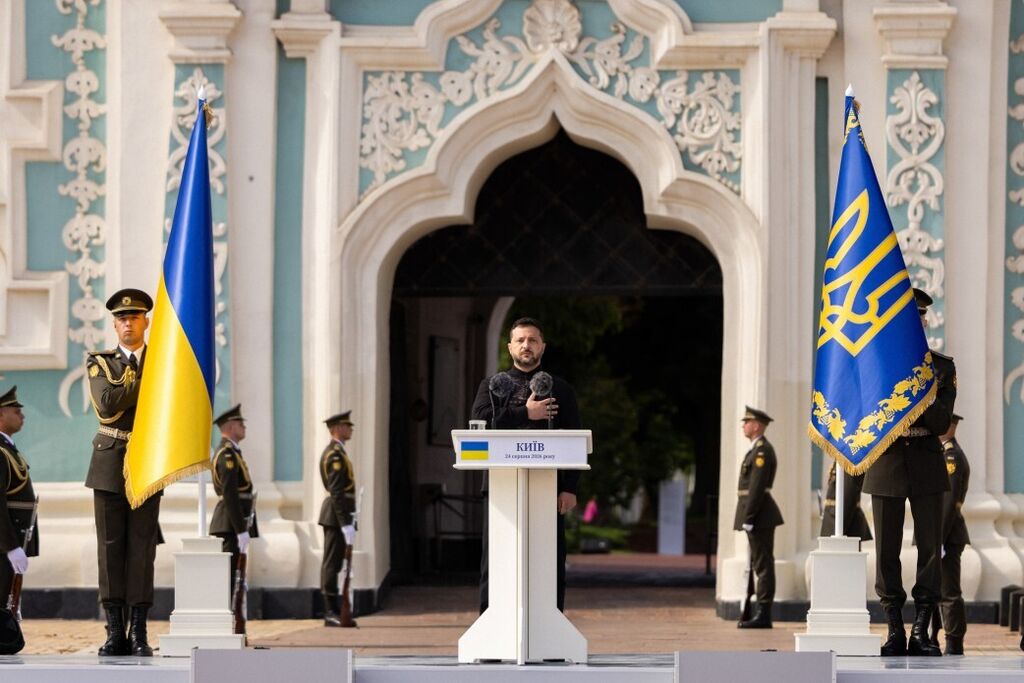 Zelensky during Independence Day in Kyiv, 2026. Photo: Office of the President of Ukraine
Domestic political instability
Another important event took place just a few days before Ukraine’s Independence Day. It was held at the Kyiv office of the European External Action Service (EEAS) – the Delegation of the European Union to Ukraine – and was attended by Kyiv-based EU diplomats. The EEAS website announced the event as ‘an open and constructive meeting between EU Member State Ambassadors at the EU Delegation and the leaders of NABU and SAPO [National Anticorruption Bureau and Specialized Anticorruption Prosecutor Office].’ The conclusion of the meeting was summed up in one sentence: ‘The EU will continue its strong support for Ukraine’s anti-corruption efforts as Ukraine moves forward on its EU path’.
The EU ambassadors likely wanted first-hand information from Ukraine’s most active and reputable watchdogs, NABU and SAPO, about the latest corruption scandals implicating top officials, including the deputy head of the president’s administration. She was allegedly involved in a large mafia-style money-laundering scheme via a state-owned bank, as well as illegal interference in the work of the judiciary. The case appears to be a follow-up to last year’s corruption scandal in the energy sector, which involved some ministers and other officials whose names have remarkably resurfaced in the new story unearthed by NABU.
Historical parallels
The conversations of the individuals under investigation, intercepted by investigators, largely resemble the ugly talks of other officials secretly recorded 27 years ago in the office of then president Leonid Kuchma. Back then, the recordings resulted in the largest political scandal in Ukraine’s history. Neither the style (criminal) nor the language (Russian) of the Ukrainian ‘elite’ recorded in both cases has changed much.
There are, however, two differences. First of all, in the old records the president was clearly and unmistakably implicated in illegal activities, appearing as a mafia boss. In the new records, there is no direct proof so far of Zelensky’s involvement in these schemes, even though the question arises of how this could happen within his closest circle, among the people whom he himself entrusted and promoted, without his knowledge.
The second difference is technical. The old records reveal an elaborate system of state-run blackmail as a political tool, employed by the police, the security service, and especially the tax administration, under the president’s supervision. The new records imply that the system is based less on coercion and more on cooptation; it is more like a shareholders’ venture than a criminal gang, and its primary goal is enrichment rather than the preservation of presidential power, as was the case under Kuchma.
Anti-corruption efforts under threat
So far, the question remains who is the boss of this new mafia-style system that operates much better – smoother and gentler – than the old one. Maybe NABU and SAPO will eventually give us an answer to this question as well. The EU ambassadors' meeting with the NABU and SAPO heads was probably not only about gathering first-hand information but also about encouragement. And it was probably also a warning to those in Ukraine who would like to stop, obstruct, or destroy these courageous institutions.
Last year, just before the ‘Mindich’ scandal came to light, Volodymyr Zelensky tried to defend his associates and restrict NABU’s investigative independence, but backtracked after mass protests and probably some signals from Western partners. Now, he did not try to defend the indefensible, but instead fired a high-ranking employee of the presidential administration and distanced himself from their wrongdoings.
The question remains who leads this new mafia-style system in Ukraine
Zelensky may not be directly responsible for any criminal deeds, but he is definitely accountable for everything that happens under his leadership and within the realm of his authority. As a professional actor and a smart person, he has proven quite good at public relations, especially on the international stage. But, as an essentially Soviet person, he appears to be attached to old habits and institutions. He inherited a neo-patrimonial system from his predecessors and kept it unchanged, filling it merely with his own people – insipid patrimonial loyalists.
In 35 years of national independence, Ukraine has not moved far from Russia in terms of the quality of its institutions, but it is far ahead in terms of civil society
Ukraine faces a deadly enemy with a much bigger population and much greater resources. It can win only if it counterbalances all these Russian advantages with higher-quality institutions – better administration, better military command, a freer and more inventive civil society. So far, in 35 years of national independence, Ukraine has not moved far from Russia in terms of the quality of its institutions or ruling elites – their mentality and political habits. But it is far ahead, and still improving, in terms of civil society, which keeps a close eye on the country's rulers and fixes dysfunctional post-Soviet institutions. That is a difficult task, but it is achievable – with due domestic efforts, some international help and maybe a bit of luck.
10 jaar RAAM: wij hebben uw hulp nodig
In 2026 bestaat RAAM 10 jaar. Het is geen vanzelfsprekendheid dat we blijven voortbestaan. Daarvoor hebben we uw hulp nodig. Met uw giften kunnen wij auteurs een bescheiden honorarium betalen, onderzoek doen en Kennisplatform RAAM overeind houden. Wij zijn een ANBI: uw gift is aftrekbaar van de belasting.


