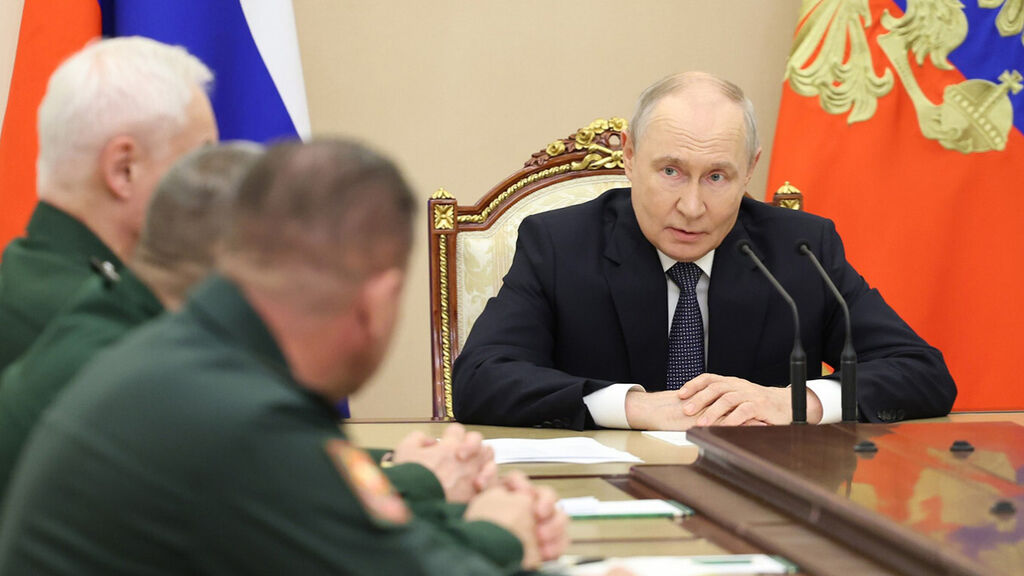

Takes on the outcomes of the Shenzhen summit have ranged from a big win for Putin to an embarrassing and merely symbolic get-together. According to Anton Barbashin, political analyst and editorial director at Riddle Russia, the meeting was not useless for Putin, but certainly not successful either.
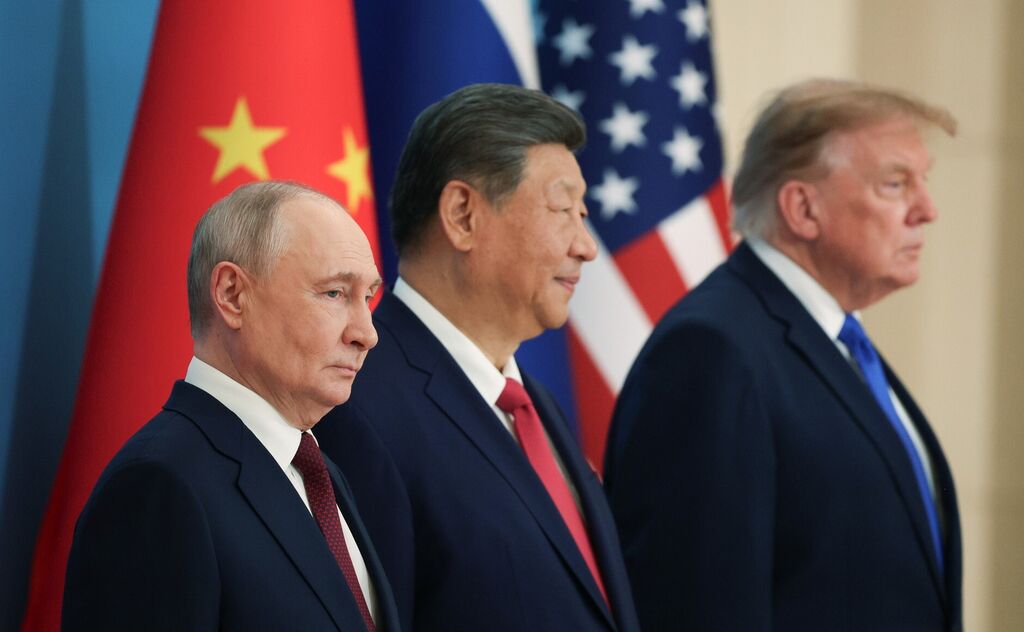 Photo: Kremlin
Vladimir Putin left the Shenzhen trilateral summit with Donald Trump and Xi Jinping not looking like the head of state of a country that has lost more than 700,000 people in a war with a much smaller neighbour that has lasted nearly five years. He looked, instead, like the leader of a great power: seated at the same table as the American and Chinese presidents, treated as a legitimate interlocutor, and included in a 'historic' trilateral declaration.
For a Kremlin that has spent nearly five years being cast as an international pariah by the West, that is not nothing. But it is mostly theatre.
The summit produced a vague peace declaration, a pledge to increase refined fuel production, and calls for United Nations reform. It did not produce sanctions relief, a Ukraine settlement, or a new institutional mechanism capable of forcing Kyiv to accept Moscow’s terms. Putin gained the appearance of being equal to the presidents of the United States and China, and of being part of the 'solution' to global problems rather than the 'problem'.
What he did not gain was the thing he actually needs: the support of China and, above all, the United States to end the war in Ukraine on Russia’s terms.

Pomp and circumstance
The Shenzhen meeting was symbolically extraordinary. Putin, Trump, and Xi jointly declared an intention to 'increase the production and supply of refined petroleum products', reaffirmed the importance of stable energy flows, and raised ideas of UN reform, nuclear risk reduction, and 'undesirable' international justice.
For Putin, however, the central gain was the format of the meeting.
Russia has long sought to replace the post-2022 narrative—Russia as a sanctioned aggressor that must be isolated—with a different one: Russia as an indispensable pole in a new multipolar order. A trilateral meeting hosted by China, with the U.S. president calling Putin 'my friend', does exactly that. It places Moscow on the same diplomatic plane as Washington and Beijing.
The meeting in Shenzhen placed Moscow on the same diplomatic plane as Washington and Beijing
Yet the summit’s practical content was rather thin. The remarks on UN reform lacked detail; the energy language was hardly new; the criticism of the International Criminal Court, which none of the three states recognises, was largely symbolic; and the nuclear risk language was abstract.
More importantly, the declaration did not bind the United States to lift sanctions, halt arms deliveries to Ukraine, or pressure Kyiv into territorial concessions. It did not address the issues Moscow actually cares about most.
The hope that Trump will deliver tangible gains for Russia has been persistent since his return to the White House, but so far has not materialized.
View this post on X
What has Putin actually gained?
The clearest benefit Putin has obtained from Trump since he came back to presidency in early 2025 is ideological and institutional.
Trump has significantly reduced or disrupted many of the instruments through which the United States has promoted democracy, human rights, civil society, and anti-corruption norms abroad. The administration’s early review and near-freeze of foreign assistance disrupted programmes worldwide.
USAID – a key foreign aid actor – underwent sweeping staff and program reductions, undermining development, governance, and civil society work that Russian authorities have long portrayed as hostile interference.
That is a gift for the Kremlin. Moscow has spent years arguing that Western democracy promotion is hypocrisy, interference, and a tool of regime change. Washington now seems to be on the Kremlin's side in its crusade against the 'rules-based order'.
It does not mean that Trump is acting on Putin’s behalf. He is not. But Putin does benefit.
Trump is not acting on Putin's behalf – he's not, but Putin does benefit
In practical terms, reduced American interest in democracy abroad may have eased some of the pressure that the Biden administration placed on Russia’s partners in places like Central Asia. That, in turn, may have created more space for governments in the region to cooperate with Moscow, including through the regular deportation of political activists and mobilisation evaders to Russia.
Trump’s leverage over Ukraine is overstated
In terms of the war in Ukraine, one should not overestimate Trump's influence. The idea that Trump can simply order Ukraine to stop fighting or at least moderate its response to Russian attacks, is a misconception.
Trump has certainly reduced American support in ways that hurt Kyiv. His administration has delayed Patriot missile shipments, criticised Ukrainian strikes on Russian oil refineries, and reportedly rejected a Ukrainian request for a 300-missile 'winter package'. Trump has also suggested that Ukraine needs a 'new president', language that Moscow naturally welcomes.
Zelensky publicly said that Ukraine would resume strikes on Russian refineries despite U.S. pressure to halt them, accusing Trump of favouring Moscow. Ukrainian strikes continued against Russian energy infrastructure, including the Novoshakhtinsk refinery in Rostov region, which suspended operations after a missile-and-drone attack.
The idea that Trump can simply order Ukraine to stop fighting is a misconception
The reduction in U.S. assistance has not left Ukraine helpless either. Europe has stepped in politically and materially. Zelensky has called for a four-party format involving Ukraine, Europe, the United States, and Russia, while continuing to press for stronger Western military support and sanctions. The EU’s new sanctions package is itself evidence that European policy has not simply followed Washington’s lead.
Russia’s diplomatic theory has been: first normalize U.S.–Russia relations; then use that improved relationship to extract concessions on Ukraine. Foreign Minister Sergey Lavrov has stated this logic openly. 'It is necessary to normalize relations on the whole to launch a comprehensive dialogue', he said in September 2026.
But by late October, Lavrov was complaining that the fundamental issues remained unresolved. 'Sanctions remain, all the sanctions from [former President Joe] Biden are echoed by the current administration', he said.
Trump’s friendliness clearly has not produced the sanctions relief Moscow wants. It has not halted Ukrainian strikes. It has not forced Kyiv into a settlement. It has not created a durable U.S.–Russia bargaining framework. The only thing that it has produced is gestures, meetings, and limited waivers.
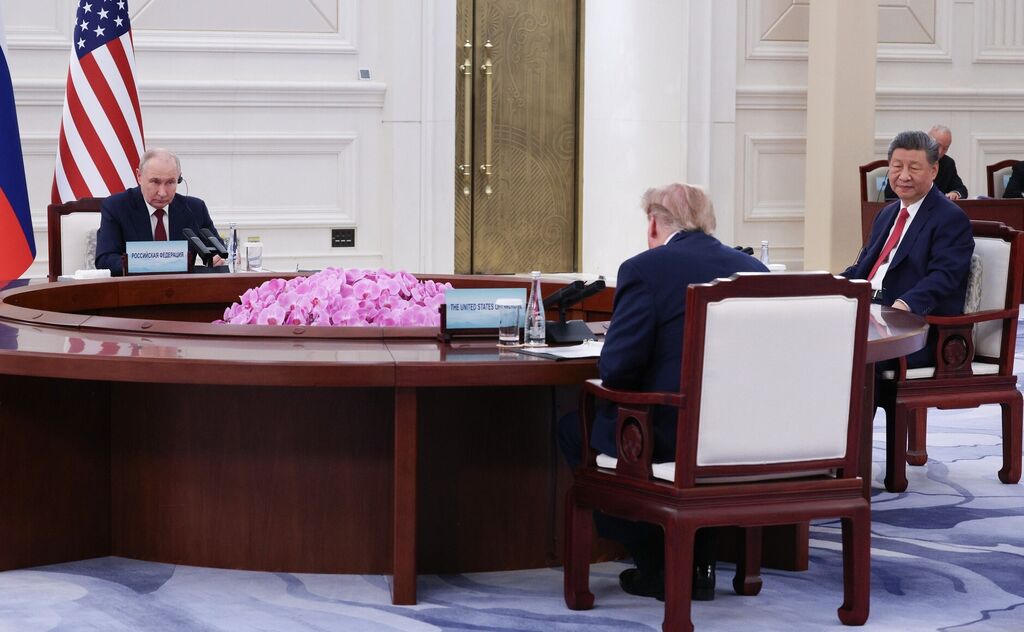 The three presidents during their trilateral meeting in Shenzhen. Photo: Kremlin
A weaker NATO?
Trump’s most consequential benefit to Putin has been his sustained weakening of NATO and the broader liberal international order.
Trump’s pressure has damaged transatlantic trust and weakened confidence in Article 5. Defence minister Hegseth has reportedly planned a cut of roughly 25,000 U.S. troops in Europe.
At the same time, Trump’s pressure has accelerated Europe's defence spending, which will make it a more capable military power. That is not the fragmented, demilitarised, and politically divided Europe that Putin envisioned.
None of the actual content of the meeting has brought Putin closer to his war aims
The summit in Shenzhen elevated Putin to one of the three most influential world leaders, even if only for a few hours. But none of the actual content of the meeting has brought him closer to his war aims.
The Kremlin will continue betting on Trump because he remains its best hope for a deal, but so far the 'friendship' has produced far less than the Kremlin had hoped for.
10 jaar RAAM: wij hebben uw hulp nodig
In 2026 bestaat RAAM 10 jaar. Het is geen vanzelfsprekendheid dat we blijven voortbestaan. Daarvoor hebben we uw hulp nodig. Met uw giften kunnen wij auteurs een bescheiden honorarium betalen, onderzoek doen en Kennisplatform RAAM overeind houden. Wij zijn een ANBI: uw gift is aftrekbaar van de belasting.