
The Kremlin is taking measures to boost voter turnout in Russia’s upcoming Duma elections, including psychology classes for 'mobilizers' tasked with persuading people to vote. In this article, first published by Meduza, Andrey Pertsev examines how these efforts reflect the authorities’ concerns about voter apathy and public discontent.
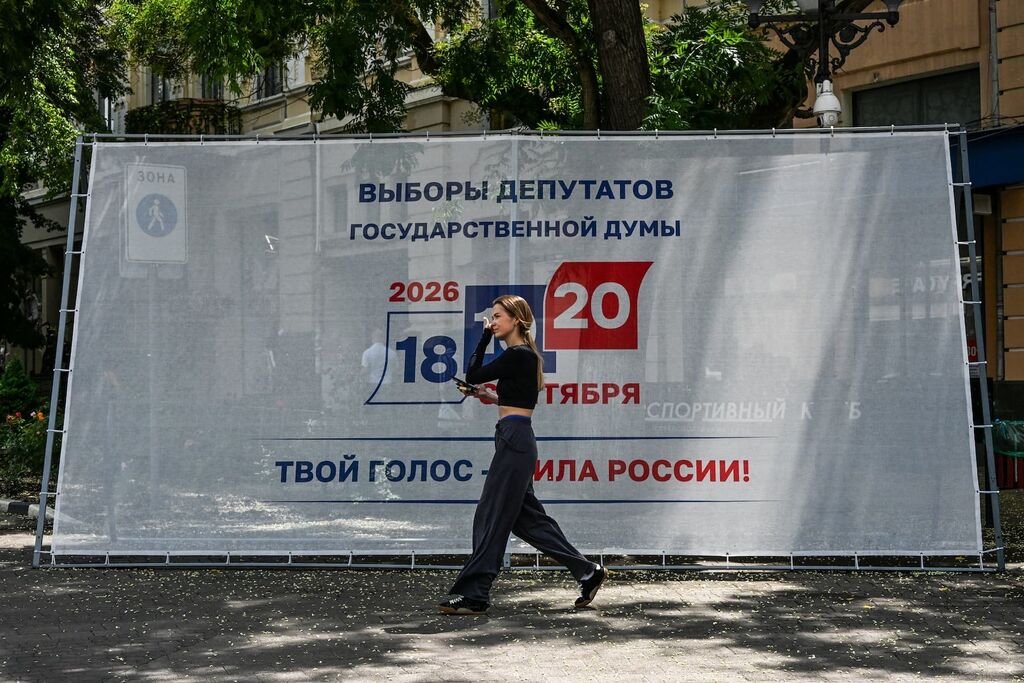 A woman walks past a campaign banner announcing September 2026 elections to elect deputies of the State Duma, in Simferopol, on the Russian-annexed peninsula of Crimea. Photo: ANP / Igor IVANKO / AFP
The political bloc of Russia’s Presidential Administration plans to step up so-called 'corporate mobilization' for this year’s elections to the State Duma, the lower house of Russia’s parliament: the practice of pressuring employees at state-funded institutions, state corporations, and major companies with owners loyal to the authorities to vote. The administration is assigning turnout responsibility to mid-level managers, whom officials internally call 'mobilizers' or 'brigade leaders.' Each oversees a group of several dozen employees and will track whether they vote.
The tactic isn’t new, but it was previously limited to certain regions and companies. It has now become widespread nationwide.
Political strategists working with the Presidential Administration and regional leadership attribute the shift to growing voter apathy and falling approval ratings for the authorities, fueled by public fatigue with the war and mounting discontent over the country’s economic crisis. The latest poll by the Public Opinion Foundation (FOM) found that approval for United Russia, the country’s ruling party, fell from 37% to 33%.
Growing voter apathy and falling approval ratings for the authorities are fueled by public fatigue with the war and mounting discontent over the country’s economic crisis
'In the past, ensuring turnout only required school vice principals, deputy chief physicians at clinics, and personnel departments at enterprises. Now the work has to be more intensive. Whoever [among those responsible for corporate mobilization] used to slack off won’t anymore,' one political strategist told Meduza.
An employee at a state corporation, two deputy governors overseeing regional political affairs, and a source in a major city administration who handles social issues told Meduza that corporate mobilization will become more targeted and precise in the first parliamentary elections held during wartime.
Personnel officers and department heads working under Presidential Administration political strategists, along with regional administration employees, previously handled this mobilization. The current campaign has also enlisted mid-level managers and rank-and-file employees.
'[Higher-level managers] offer this role to people who are socially active, career-minded, and want to stay on good terms with their bosses. If there’s no one willing and fitting that description, they’re appointed on a voluntary-compulsory basis,' a municipal official said, describing the recruitment process.
Mobilizers get psychology training
'Brigade leaders' go through training courses covering, among other things, psychology and 'social architecture,' meant to help 'mobilizers' prepare people for turnout at polling stations in advance, a municipal official and a political strategist who works with the leadership of several Russian regions told Meduza. In some regions, budget-funded employees and state corporation workers must bring not only the workers 'assigned' to them but also relatives and acquaintances — one to three people — to the polls, the political strategist added.
Another political strategist, who works with both regional administrations and the Presidential Administration, said 'mobilizers' had already been active in past campaigns in regions with 'a high degree of administrative pressure' and at some companies with Kremlin-loyal leadership.
'In the Moscow region, state-funded institutions already had these overseers during the last State Duma elections [in 2021]. Now it’s spreading to regions where administrative resources weren’t previously used so harshly, but times are different now, and control needs to be tightened,' he explained.
A deputy governor of one of Russia’s major regions, himself a former political strategist, said he had personally worked with 'brigade leaders.' 'This is also used in U.S. elections, just by parties. We borrowed the experience,' he said with a laugh. Meduza’s source claimed that American businessmen affiliated with political parties 'mobilize' employees at their companies.
'This is also used in U.S. elections, just by parties; we borrowed the experience,' he said with a laugh
The official said he sees little point in training 'mobilizers' in psychological techniques meant to boost turnout: 'Whoever already understands [that people need to be made to come vote] doesn’t need to be taught, and whoever doesn’t understand won’t learn.' He said corporate mobilization is changing:
'Before, [those responsible for turnout among state-funded employees] were lazy about it. Say you need to bring in 100 people, they’ll bring them in. But among them, the “positive” ones [those voting for pro-government candidates] amount to at best half, or maybe just 30. You really have to work with people to ensure genuinely high-quality turnout.'
The Presidential Administration designed 'brigade leaders' who work with small groups to simplify corporate mobilization by providing 'a greater focus of control,' the deputy governor added.
Tighter control may backfire
Such targeted work — the essence of which is tighter control — benefits the authorities. But for employees at state-funded institutions and Kremlin-loyal businesses, excessive pressure from 'mobilizers' is likely to have the 'opposite effect': 'You’re already fucking sick of everything, and now on top of that a coworker is riding you, making you go vote.'
For employees at state-funded institutions and Kremlin-loyal businesses, excessive pressure from 'mobilizers' is likely to have the 'opposite effect
Even research from state-run sociological centers shows Russians are experiencing frustration and anxiety without any help from 'brigade leaders.' According to the results of a July poll by the Russian Public Opinion Research Center (VTsIOM), the share of respondents who believe the country’s hardest times are still ahead rose to 66%, the highest figure since spring 2020. Combined pessimism reached 78%.
According to data from 2021 — Meduza could not find more recent figures — about 17.5 million Russians work in the state-funded sector. No precise official statistics exist on state corporation employment in Russia, but figures published by individual companies suggest several million more people work at these companies.
This article was first published with Meduza.
10 jaar RAAM: wij hebben uw hulp nodig
In 2026 bestaat RAAM 10 jaar. Het is geen vanzelfsprekendheid dat we blijven voortbestaan. Daarvoor hebben we uw hulp nodig. Met uw giften kunnen wij auteurs een bescheiden honorarium betalen, onderzoek doen en Kennisplatform RAAM overeind houden. Wij zijn een ANBI: uw gift is aftrekbaar van de belasting.


